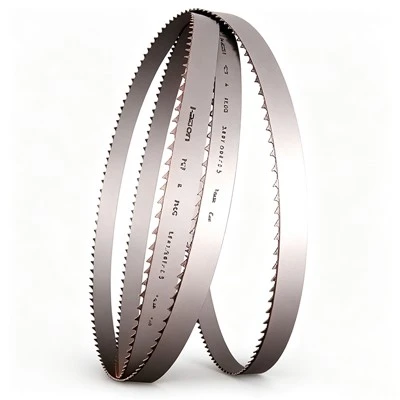


Product Introduction
Electroplated diamond edge on a stainless steel backing band, welded to loop length and supplied for band saw machines used in sapphire blank squaring, bricking and dimensioning. The blade runs on the same grinding principle as other diamond band products, but the specification is set by sapphire's single-crystal structure rather than by stone abrasiveness alone. The working output is a dimensioned blank with controlled edge damage, ready for lapping and polishing-not a finished optical surface straight off the saw.

Technical Specifications
| Parameter | Value |
| Backing band material | Carbon steel / stainless steel (heat- and corrosion-resistant) |
| Diamond edge | Electroplated diamond grit |
| Edge pattern | Continuous · Wavy · Zigzag · Diamond-pattern |
| Customizable width | Width adjustable within a small range (e.g. ±5 mm) against the ordered figure |
| Customizable length | Welded loops to machine wheel spacing; length tolerance ±100 mm |
| Compatible workpiece | Sapphire substrates, quartz glass, ceramic substrates, silicon carbide |
| Coolant | Water-based coolant or cutting fluid required at the cut zone |
| Diamond grit size/Thickness/Band tension/MOQ | Detailed data available upon request |
| Lead time | Welded loops 7–15 days depending on length and quantity; open coils quoted separately |
Width and length are not stocked in every increment. Sapphire work usually fixes the loop length from the machine first, then the width from the guide and wheel capacity. The ±5 mm width and ±100 mm length adjustments are production tolerances, not a substitute for giving the machine model at quotation.
Where This Blade Sits in a Sapphire Process
Sapphire blanks arrive at the saw in two forms that pull the specification in different directions: as-grown boules or bricked rectangular blocks that need squaring and cropping before wafering, and pre-shaped near-net sections that need edge trimming. The band saw's advantage is size. A loop can span a work envelope that an ID saw cannot reach, and it cuts a straight line through a block without the setup change a wire saw requires for each new orientation.
The limitation is edge integrity. In sapphire, band saw cutting produces edge chipping that is more pronounced than on an ID saw or a diamond wire saw, because the band presents a wider contact area and the single-crystal lattice fractures rather than deforms at the cut exit. This blade is specified for rough dimensioning and stock removal before finishing-removing the saw-cut allowance, squaring a block to a lapping datum, or cutting a blank down to a size the next operation can handle. It is not the tool that produces the final polished edge, and a purchaser comparing it against a wire saw on edge finish is comparing two different process steps.
For sapphire fabricators, the practical reading is: the band saw decides how much material the lapping and polishing stages have to remove, and how much subsurface damage those stages have to grind through. A blade that cuts fast but leaves deep fracture damage pushes the cost downstream. A blade run at conservative parameters leaves a shallower damage layer and a more predictable lapping allowance.
Edge Pattern and Grit Selection
The edge pattern controls how the diamond contacts sapphire and how heat and fines leave the cut.
Continuous edge is the pattern for straight, uninterrupted cuts through sapphire blocks and bricked sections. The uninterrupted diamond ribbon distributes contact pressure evenly across the cut length, which matters on a single crystal because point loading at the band edge is where fracture initiates. Continuous edge is the default specification for squaring and straight cropping.
Wavy or zigzag edge increases unit contact pressure at the high points of the pattern. This is used where the band needs to establish a bite into a hard, dense surface without increasing the machine feed force-typically on the first pass into a rough or as-cut sapphire surface. The trade-off is a slightly wider damage zone at the cut entry.
Diamond-pattern and semicircular profiles change the stress distribution around the cut and are used for contour or partial-depth work where the band is not making a full-width straight pass through the block.
Grit size follows the same logic as the process stage. Coarser grit removes stock faster and is matched to squaring passes where the lapping allowance is generous. Finer grit leaves a shallower fracture layer and is specified where the blank is already close to final thickness and the next step is a fine lap rather than a coarse grind. The exact grit designation for a given sapphire operation depends on the block size, the machine's band speed and the damage depth the finishing line can tolerate; that figure is confirmed at quotation rather than assumed from the stone-cutting range.
Coolant and Thermal Control
Sapphire's thermal expansion behaviour means heat at the cut does not stay at the cut. Residual stress from a hot band can show up as crystal defects and warpage after the blank has been lapped flat, and those defects are not visible on the as-cut surface. Coolant delivery is therefore a process requirement, not a machine accessory.
The blade is run with water-based coolant or a sapphire-compatible cutting fluid directed at the point where the diamond contacts the work. The coolant does two jobs: it carries heat out of the cut zone and it flushes sapphire fines that would otherwise pack into the diamond layer and blunt the edge by loading rather than by wear. Machines with a weak or misdirected nozzle show glazing on the band before the diamond layer is consumed-that is a coolant problem, not a blade-life problem.
Weld, Backing Band and Loop Fit
The backing band is heat-treated carbon steel or stainless steel. Stainless is the more common specification for sapphire workshops because the process runs wet and the band sits in a coolant environment between cuts; carbon steel is quoted where the machine and handling practice keep the band dry between shifts.
Loops are joined and tension-checked before shipment. The weld is inspected for straightness across the band width and for step height at the joint. On sapphire this check matters more than on stone: a step at the weld changes the local contact pressure and leaves a mark or a chipped line at the same point on every revolution. Each loop is coiled, labelled with length, edge pattern and grit, and the weld position is marked so the operator can index it away from the work entry on the first pass.
The band is tensioned on the machine to the figure supplied with the order. Sapphire's hardness means the band must resist deflection under cutting load; an under-tensioned loop wanders in the cut and produces a wedge-section blank that costs lapping time to recover.
Customization and Wholesale Supply Format
Sapphire work rarely fits a catalogue loop length. Lengths are welded to the machine's wheel spacing, and widths are set from the guide capacity and the block size. For distributors, supply is either welded loops ready to fit or open coils where the distributor welds on site. Coils suit distributors serving several sapphire machine brands because one coil can be cut and joined to more than one loop size; loops suit end users who do not run a welding station.
Laser marking of distributor name, logo and specification on the band is available for bulk orders. Packaging is export-grade: individual coil wrap, rust-inhibiting paper or film, then reinforced carton or plywood case for sea freight.
Quality Control Before Shipment
Weld straightness and step height - checked across the band width on every loop.
Band length and width - measured against the order, with the ±5 mm / ±100 mm adjustment range recorded.
Diamond edge coverage - visual inspection for bare patches, uneven grit distribution or plating buildup that would change the contact footprint.
Coil set - coiled to a diameter that does not set a permanent bend at the weld.
A batch record covering length, width, edge pattern, grit and weld inspection travels with each shipment for distributors who pass documentation to their own customers.
FAQ
Q: Can a band saw replace a wire saw for sapphire wafering?
A: No. The band saw dimensions the blank before wafering; it does not produce the surface finish or edge quality a wire saw delivers on the wafering step. In sapphire, band saw edge chipping is higher than on a wire saw because the band presents a wider contact area to a brittle single crystal. The band saw's role is to bring the block to a size and squareness that the wire saw or lapping line can take over, and to do it on work sizes that an ID saw cannot accept.
Q: What controls edge chipping on this blade?
A: Three variables sit with the operator: feed rate, coolant delivery and band tension. Sapphire tolerates a narrow window on feed; pushing the band to recover cycle time increases fracture at the cut exit and deepens the subsurface damage layer that lapping has to remove. Coolant must reach the diamond contact point, not flood the general area. Tension must match the figure supplied with the loop. The blade's contribution is the edge pattern and grit, which set the contact pressure; the operator's contribution is keeping the band inside the stable window.
Q: Which edge pattern should I start with for sapphire blocks?
A: Continuous edge for straight squaring and cropping, because it spreads contact pressure across the cut and avoids the point loading that initiates crystal fracture. Wavy or zigzag edge is specified when the band needs a more aggressive bite into a rough as-cut surface. Diamond-pattern profiles are for contour or partial-depth work. Tell us the operation-squaring, bricking, edge trimming or contour-and the block dimensions, and the pattern follows from that rather than from a default.
Q: What grit do you recommend for sapphire?
A: Grit is matched to the stage of the process: coarser for squaring passes where the lapping allowance is generous, finer where the blank is close to final thickness. The exact grit figure depends on band speed, block size and the damage depth the finishing line can absorb, so it is confirmed against the operation at quotation. We do not quote a single grit as a blanket sapphire specification.
Q: What information do you need to quote a sapphire blade?
A: Machine make and model, or the wheel spacing and maximum band width the guides accept; the sapphire workpiece form (boule section, bricked block, near-net blank) and its dimensions; the operation the blade is bought for; and whether you want welded loops or open coils. Grit and edge pattern follow from the operation; thickness and tension figure are confirmed against the machine before the order is released.
Hot Tags: sapphire cutting saw blade, China sapphire cutting saw blade manufacturers, suppliers, factory, bi metal bandsaw blade, carbide tipped bandsaw blade, coated metal bandsaw blade, cold cut bandsaw blade, metal cutting bandsaw blade, Quality Bandsaw Blades