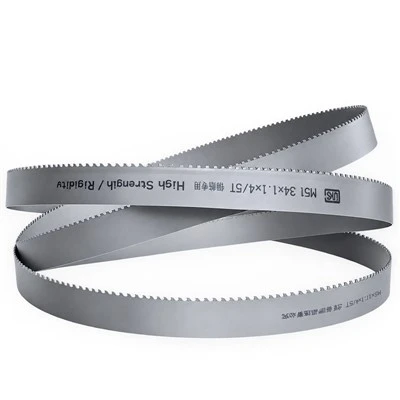


Product Introduction
A stone fabrication shop that runs sandstone, slate and engineered quartz through the same band saw cannot hold four blade specifications in stock and wait for each job to arrive. This page covers the blade built for that changeover condition: an electroplated diamond edge on a heat-treated stainless band, welded to the machine's loop length, specified against the hardest material in the shop's mix rather than the softest. The edge pattern and grit are fixed at order stage from the stone list, not from a single-material default.

Technical Specifications
| Parameter | Value |
| Blade material (backing band) | Carbon steel / stainless steel (heat- and corrosion-resistant) |
| Diamond edge | Electroplated diamond grit |
| Edge / tooth profile | Continuous · Wavy · Zigzag · Diamond-pattern |
| Diamond grit | 35/40 (faster stock removal) · 50/60 (finer edge finish) |
| Customizable width | Continuous edge: 10–80 mm; other profiles: 10–100 mm depending on profile |
| Customizable length | Welded loops up to 10,000 mm; short loops from 1,200 mm for compact machines |
| Cutting method | Wet cutting required; water or coolant supply at the cut zone |
| Lead time | Standard specifications ship in 3–7 days; customized loops 7–15 days depending on quantity |
The feed and surface-speed bands above are working ranges by material group, not fixed machine settings. A shop that runs group A and group B on the same saw will normally run group B at the lower end of its band and reduce feed further on the first pass after a changeover, because residual stone fines from the previous job change the coolant condition at the kerf.
What the Blade Is Built to Cut
The blade's working range splits by stone structure, and the split matters at the purchasing stage because a shop that buys one specification for all three tiers will overpay on one end and underperform on the other.
Sandstone, slate and limestone sit in the blade's primary range. These stones grind into a free-cutting swarf at the feed and surface-speed bands in the table, and the continuous edge pattern keeps contact pressure even across slab width. Sandstone's grain structure is more abrasive than limestone's, so blade life is tracked by linear metres per stone type rather than a single shop-wide figure.
Engineered quartz sits in a qualified range. The resin binder changes the cut: swarf turns tacky rather than powdery, and coolant flow has to clear resin-loaded fines from the kerf or the diamond layer loads and stops cutting. Feed drops to the 0.8–1.5 m/min band, and the first pass after a changeover from limestone runs slower until the coolant runs clear.
Granite and high-quartz natural stone sit outside the standard build. Quartz content close to the diamond's own hardness wears the electroplated layer by abrasion instead of grinding, and the blade is quoted against a different diamond concentration. A shop that runs granite as a regular line should state it at inquiry; the Stone Slicing specification is not the granite specification with a different label.
Backing Band, Diamond Edge and Weld
The band is heat-treated stainless steel for shops that run wet across multiple stone types; carbon steel is quoted where the saw is wiped down between shifts and coolant is not left standing on the band. Tensioning happens before the diamond layer is applied, so the loop holds its set across the wheel diameter through a job change without re-tensioning between materials.
The weld is where a mixed-stone shop sees problems first. A step at the joint that leaves a faint mark on limestone will chip engineered quartz at the exit edge, because the resin binder in quartz slabs fractures rather than grinds at a pressure spike. Every loop is checked for straightness across the band width and step height at the joint; the weld position is marked on the coil so the operator can index it away from the work entry on the first pass after a material change.
Changeover practice
A band saw that moves from limestone to engineered quartz carries limestone fines into the coolant line and onto the band surface. The sequence that keeps the second job clean is short:
Flush the coolant line and the kerf zone before the first quartz cut. Limestone fines that stay in the nozzle mix with quartz resin and pack the diamond layer at the contact point.
Run the first pass after changeover at the low end of the new material's feed band. The swarf colour confirms the switch: limestone runs light grey, engineered quartz runs darker and tackier, and a grey swarf on a quartz job means the line has not cleared.
Check the weld mark position before restarting. A weld that was indexed away from the limestone entry may sit at the quartz entry after the slab length changes, and the quartz exit edge is where a weld step shows first.
Wholesale format and customization
Distributors selling into mixed-stone shops carry a narrower SKU set than the material list suggests. One coil at a given width and edge pattern covers group A and group B loop lengths, because the loop length is set by the machine, not by the stone. Open coils let the distributor weld to the customer's wheel spacing without holding a separate finished loop for every saw in the territory. Welded loops suit end users who do not run a welding station and want the weld inspection record with the shipment.
Laser marking of distributor name, logo and specification on the band is available on bulk orders. Packaging is individual coil wrap, rust-inhibiting film, then reinforced carton or plywood case for sea freight. Standard widths ship in 3–7 days; custom loop lengths in 7–15 days.
Quality Control Before Shipment
Every batch is checked on the dimensions that affect cutting behavior, not only on appearance:
Weld integrity - joint aligned across the band width, no gap or step that would print onto the stone.
Band length and width - measured against the order specification, with tolerance recorded.
Diamond edge coverage - visual inspection for bare patches or uneven grit distribution along the cutting edge.
Coil set and memory - the blade is coiled to a diameter that avoids a permanent bend at the weld when unpacked.
A batch certificate recording length, width, grit and weld inspection result accompanies each shipment for distributors who pass documentation to their own customers.
FAQ
Q: Can the same blade run sandstone and engineered quartz on one machine?
A: The same loop can, provided the changeover sequence is followed: coolant flush before the quartz job, first pass at the low end of the quartz feed band, and a swarf check before production speed is restored. The blade does not change between the two materials; the operating window does. A shop that runs both without flushing carries limestone fines into the quartz cut and sees resin-loaded diamond before the blade has done its normal work.
Q: Why does engineered quartz swarf turn tacky, and what does it mean for blade life?
A: The resin binder in quartz slabs softens under cut heat and mixes with stone powder into a tacky paste. That paste packs the diamond layer if coolant flow does not clear it, and a packed layer stops grinding and starts rubbing. Blade life on quartz is shorter than on limestone at the same linear metres, which is why group B life is tracked separately rather than averaged into a shop-wide figure.
Q: For a distributor, does one coil cover both material groups?
A: One coil at a given width and edge pattern covers both groups because loop length is set by the machine, not the stone. The distributor welds to the customer's wheel spacing and the same coil stock serves a limestone account and a quartz account in the same territory. The grit choice is the one specification decision that follows the material mix, and it is fixed at order stage per coil.
Q: How is blade life tracked when the shop cuts more than one stone type?
A: By linear metres per material group, not a single shop-wide number. Limestone and sandstone at group A parameters wear the layer at a different rate from engineered quartz at group B feed, and a blade pulled at the average figure will either be changed early on limestone or run glazed on quartz. Distributors passing blades into mixed-stone shops typically record metres per group and set reorder triggers per group.
Hot Tags: stone slicing bandsaw blade, China stone slicing bandsaw blade manufacturers, suppliers, factory, bandsaw blade for angle cutting, cobalt bandsaw blade, low tooth count metal bandsaw blade, metal bandsaw blade, metal cutting bandsaw blade for nickel, Quality Bandsaw Blades