

Product Introduction
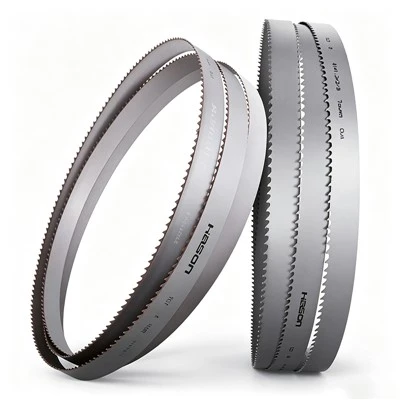
Electroplated diamond grit on a stainless steel backing band. For cutting marble slabs and blocks on band saw machines where carbide and bi-metal teeth cannot hold an edge. The blade removes material by grinding rather than toothed cutting, which is why it holds dimensions in abrasive stone that dulls conventional teeth within minutes.

Specifications
| Parameter | Value |
| Width range | 10–80 mm |
| Thickness range | 0.3–1.25 mm (9 standard gauges) |
| Diamond grit | 35/40, 40/50, 60/80, 100/120 |
| Edge configuration | Continuous / Segmented |
| Backing material | Stainless steel (standard) or carbon steel |
| Diamond hardness | 9.5 Mohs |
| Available lengths | Welded to machine wheel spacing; contact us with your center-to-center dimension |
| Tooth profile options | Continuous, wave, serrated, diamond-pattern |
Width and length can be adjusted within a narrow window-typically ±5 mm on width and ±100 mm on length-without changing the base band specification. Anything outside that range requires a different backing strip and a new weld setup.
Continuous vs. Segmented Edge
Continuous edge is the default for marble up to roughly 25 mm in section. The uninterrupted diamond coating leaves a consistent scratch pattern and reduces edge chipping on soft, veined stone. Segmented edge opens gullets between diamond segments; the gaps clear slurry and allow coolant to reach the cut interface, which matters when slab thickness exceeds 25 mm or when the saw runs at higher amperage.
For marble specifically, grit selection runs finer than for granite. 60/80 grit is the common starting point for clean slab edges; 40/50 cuts faster but leaves a more pronounced scratch pattern that may require additional finishing passes. 100/120 is reserved for thin-section work where surface finish is the primary constraint and feed rate can be sacrificed.
Operating Parameters
Band speed for marble on a diamond band saw runs 1,800–2,200 SFPM. Exceeding that range generates heat at the diamond–stone interface faster than the coolant can remove it, and the backing band begins to lose tension. Coolant is not optional: a minimum of 1.5–2 gallons per minute delivered directly to both sides of the kerf is the floor for most bridge-style band saw operations. Splash cooling is insufficient-the water must reach the point where the diamond contacts stone.
Feed rate should be set so the saw motor draws steady amperage without surging. A fluctuating load reading usually indicates the blade is glazing (diamonds dulled but not fractured away) or the segment gullets are packing with slurry. Reducing feed pressure briefly and confirming coolant flow corrects most glazing before it becomes blade damage.
FAQ
Q: Can one blade cut both marble and granite?
A: A blade ground for granite will cut marble, but the edge finish will be rougher than necessary and the finer abrasive behavior of marble can accelerate diamond pull-out on a grit selected for harder stone. For shops cutting both materials regularly, keep separate blades: 60/80 grit continuous for marble, 40/50 or coarser segmented for granite.
Q: What causes chipping on the exit edge of a marble cut?
A: Exit chipping on marble is usually a support problem before it is a blade problem. The stone needs continuous backing at the point where the diamond exits the bottom of the kerf. If support is adequate, check grit: a coarser grit than necessary will leave a larger fracture zone on soft marble. 60/80 grit continuous edge is the corrective starting point.
Q: Do you supply unjoined coils for our own welding?
A: Yes. The blade is available as open coil in the same backing, width, thickness, and grit specification as the welded loops. State the coil length required; standard coil lengths cover typical distributor welding benches.
Q: What coolant flow does this blade require?
A: At least 1.5–2 GPM to the cut interface, both sides of the kerf. Higher flow is acceptable and often beneficial on thick sections. The limiting factor is not the blade's tolerance for water but the machine's coolant delivery capacity.
Q: How does the price compare with a brazed diamond band?
A: Electroplated diamond band sits below brazed construction on initial cost and above it on replacement frequency for high-volume block cutting. For slab profiling, architectural trim, and mixed-material shops where the blade is not in continuous production, electroplated gives the lower cost per finished cut. For continuous block slicing, brazed diamond is the more economical format over the full blade life.
Hot Tags: marble cutting bandsaw blade, China marble cutting bandsaw blade manufacturers, suppliers, factory, Bi metal Bandsaws for Metal, Carbide Bandsaw Blade for Metal, metal bandsaw blade for pipe, metal bandsaw blade for tube, tungsten bandsaw blade, variable tooth bandsaw blade