

Product Introduction
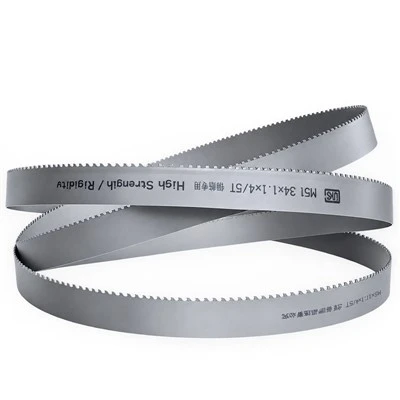
Electroplated diamond abrasive band for graphite block sizing, electrode blank cutting, and contouring of graphite components. Single-layer diamond grain on a high-tensile steel backing, supplied as welded loops or open-ended coils. Width and length adjusted to the machine within ±5 mm and ±100 mm.
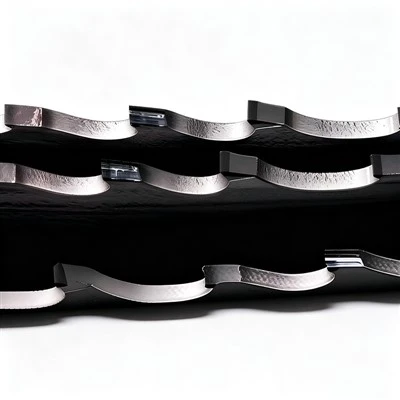
Continuous edge for graphite block and electrode blank cuts; segmented and serrated profiles available for interrupted sections and curved work
Grit 35/40 and 50/60 held as standard options; 80/100 and finer grits quoted against the surface finish requirement
Wet cutting is the expected production condition. Dry running is limited to short cuts where dust control is handled at the machine
Each welded joint ground flush and checked on an optical measuring system before packing
MOQ 5 pcs; standard widths dispatched in 48 hours, custom length and grit combinations in 7–14 working days

Graphite Removal and the Abrasive Edge
Graphite cuts through abrasion, not through a toothed chip. A steel or carbide tooth engaging graphite under feed pressure meets a material that offers no plastic deformation before fracture; the edge loads, the graphite surface spalls, and the resulting cut face carries chipping that is often not visible until the part reaches EDM or final inspection. An electroplated diamond band replaces the point load of a tooth with distributed diamond contact. The single-layer grain sits directly on the steel surface without a sintered matrix between diamond and workpiece, and it reaches full cutting efficiency at startup without a break-in cycle.
For EDM electrode blanks, this distinction matters at the first operation. A sawn graphite block that leaves a fractured edge or a tapered kerf pushes corrective machining downstream, where the part is already close to final geometry. The band removes graphite as fine powder and holds the cut wall without the tooth-impact mechanism that initiates edge spalling in toothed blades.
Backing, Bond and Joint Geometry
The backing is a high-strength tensile steel strip. Graphite is abrasive but not hard in the way fired ceramic is; the wear mode on the band is three-body abrasion from graphite powder migrating between the backing and the guide surfaces, plus loading at the joint where the diamond layer ends and the steel resumes. A backing with fatigue resistance under cyclic bending at the wheel diameter keeps tension distribution stable as the band runs, rather than developing a low-tension zone at the weld.
The electroplated nickel bond fixes diamond particles with a bonding strength above 50 MPa, which is the figure that governs whether grain survives the abrasive graphite stream or sheds early and changes the kerf. Bond strength is not a specification the buyer can measure on receipt, so the practical verification is joint behavior. A flush, straight joint is where bond quality and backing rigidity meet: a joint dressed proud of the backing marks the graphite once per revolution and creates a repeating witness line; an under-dressed joint leaves a step that collects powder and runs hot. Sipu checks every diamond band joint on an optical system rather than sampling a batch, and the inspection result is recorded against the blade before it is packed.
Grit Selection: Removal Rate Against Edge Condition
Graphite grit choice sets the trade-off between how fast the band removes material and how much edge preparation the sawn face requires downstream. Coarse grit (35/40) opens the cut faster and clears powder more freely; it is the first-cut choice for large graphite blocks where the sawn face will be machined anyway. Medium grit (50/60) is the working range for conventional graphite mold and electrode blank processing, balancing removal against a face that does not demand immediate corrective milling. Finer grit (80/100 and above) reduces edge chipping on thin ribs and small electrode features, at the cost of lower removal rate and higher heat at the cut zone if feed is pushed.
The grit decision should follow the thinnest feature in the part, not the overall block size. A graphite electrode with a thin rib section cut with a coarse-grit band may clear the bulk of the blank quickly and then chip the rib on the same pass. In that case a medium-grit band run at a lower feed on the finishing pass is the more economical route than a coarse band followed by a separate finishing operation. Tell us the minimum rib or wall thickness and the downstream allowance; the grit recommendation is built around the feature that governs scrap risk.
Dust, Coolant and the Machine Interface
Graphite powder is the process condition, not a byproduct that can be ignored. The powder is electrically conductive, settles on guides and wheel surfaces, and re-enters the cut if extraction at the nozzle is weak. A band running without adequate extraction carries powder back through the kerf, which increases abrasive wear on the backing and produces a cut face with a loaded, smeared appearance rather than a clean abrasive pattern.
Wet cutting suppresses dust at the source and carries powder away from the joint. The band and bond tolerate water-based coolant; the limitation is machine-side delivery. Flood coolant directed at the entry and exit of the kerf is the production configuration. Mist cooling does not move enough volume to clear graphite powder and should not be counted on for continuous cutting. If the saw is set up dry with a high-volume dust collector, short cuts and trimming operations are feasible, but the collector must be sized to the powder generation rate; recirculated graphite dust is the most common cause of a band that cuts well for the first hour and then begins to wander.
Band speed for graphite sits in a wide window because the abrasive edge, not a tooth pitch, sets the removal mechanism. Published band saw data for carbon and graphite list surface speeds from roughly 1,000 to 4,000 SFPM, with graphite composite running 1,500–3,000 SFPM. Start at the lower end of the machine's range and raise speed only after confirming that extraction and coolant are keeping the kerf clear. Speed without dust control accelerates backing wear without improving the cut.
Where This Band Fits in Graphite Processing
This band is specified for graphite that will be machined into EDM electrodes, semiconductor components, continuous casting dies, and structural graphite parts. The sawn face serves as a dimensional baseline; a cut with straightness of ≤0.02 mm/m and dimensional tolerance within ±0.05 mm gives the finishing operation a predictable allowance rather than a variable one. In the published case data for electroplated diamond bands on graphite, cutting force runs more than 40% below conventional tooling, and yield on graphite parts has been reported above 95% where edge chipping is the primary scrap mode.
It is not the first specification for graphite composite with a metal or polymer matrix, where the second phase changes the abrasive response; nor for high-volume rough slabbing where a carbide-grit or coarse-tooth band may carry a lower unit cost and the sawn face has no downstream precision requirement. If the graphite grade is fine-grain, isotropic, or copper-impregnated, send the grade designation. Fine-grain grades hold an edge better but load the band faster; copper-impregnated grades conduct heat differently at the cut and may call for a different grit and feed combination.
Ordering, Marking and Export Packing
Standard widths and grit combinations ship from stock in 48 hours against the 5-piece MOQ. Custom length, non-standard grit, and edge profile changes run 7–14 working days. Width and length are matched to the machine's wheel spacing and tension stroke within ±5 mm and ±100 mm, so the quote is built against the machine model and existing blade dimension rather than a catalog line.
OEM marking is applied after joint inspection: brand name, part number, and grit designation laser-marked on the backing. Each band is oiled at the joint, wrapped in VCI film, and packed in a reinforced plywood crate for sea freight. The VCI wrap is concentrated at the joint zone because that is where exposed steel and the diamond-to-steel transition are most sensitive to moisture in transit; the diamond layer itself does not corrode, but a joint that arrives with surface oxidation will not run straight until the oxidation is dressed out.
FAQ
Q: What is the difference between this carbon steel blade and your M42 bi-metal blade?
A: This blade has a high-carbon steel body and induction-hardened teeth. It is intended for mild steel, low-carbon steel and non-ferrous work. M42 has a cobalt HSS tooth tip and a alloy backing; it holds hardness at higher cutting temperatures and is the correct choice for stainless steel, tool steel and high-alloy stock.
Q: What is the MOQ, and can I test samples before a bulk order?
A: MOQ is 10–20 welded loops or 5 coils. Sample orders are available for quality testing before a bulk run.
Q: Can you weld to a specific machine length and laser-mark our brand?
A: Yes. Welded loops are made to the length you specify. For bulk orders, laser marking is available for your brand name, logo and tooth specifications on each blade.
Q: What is the lead time for standard sizes and custom orders?
A: Standard specifications ship within 48 hours from stock. Custom lengths and bulk orders take 7–14 working days.
Q: How are the blades packed for sea freight, and how long is the anti-rust protection?
A: Each blade is coated with anti-rust oil, wrapped in VCI paper, vacuum sealed and packed in reinforced cartons or plywood crates. The packing is rated for 60+ days of sea freight.
Hot Tags: graphite cutting bandsaw blade, China graphite cutting bandsaw blade manufacturers, suppliers, factory, bandsaw blade for copper, bandsaw blade for metal tubing, bandsaw blade for steel, M42 Metal Bandsaw, metal bandsaw blade for tube, Quality Bandsaw Blades