


Product Introduction
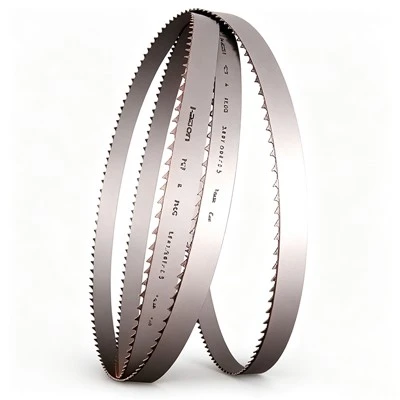
If you are sourcing metal cutting band coil for resale or for your own weld station, the decision usually comes down to three variables: edge grade, coil consistency, and whether the supplier can hold tolerances across repeat orders. Sipu manufactures coil in M42 and M51 bimetal, from 13 mm to 54 mm width, in standard 100 m and 200 m put-ups with an option for custom coil lengths. The coil is oiled, VCI-wrapped, and packed for sea freight - the same format distributors use to weld loops on demand for local machine shops and fabrication accounts.
This page is written for buyers who already know they want coil rather than finished loops. If you are weighing coil against welded loops, the short version is this: coil lowers your per-meter landed cost and lets you carry less finished-goods inventory, but it only pays off if your weld process is repeatable and your operators can maintain tooth alignment after the weld. Sipu supplies both formats, so the recommendation here is not driven by what we prefer to ship - it is driven by what your volume and machine park can absorb.

Why M42 and M51 - and When to Choose Which
M42 and M51 are not interchangeable "good / better" options. They solve different cutting economics.
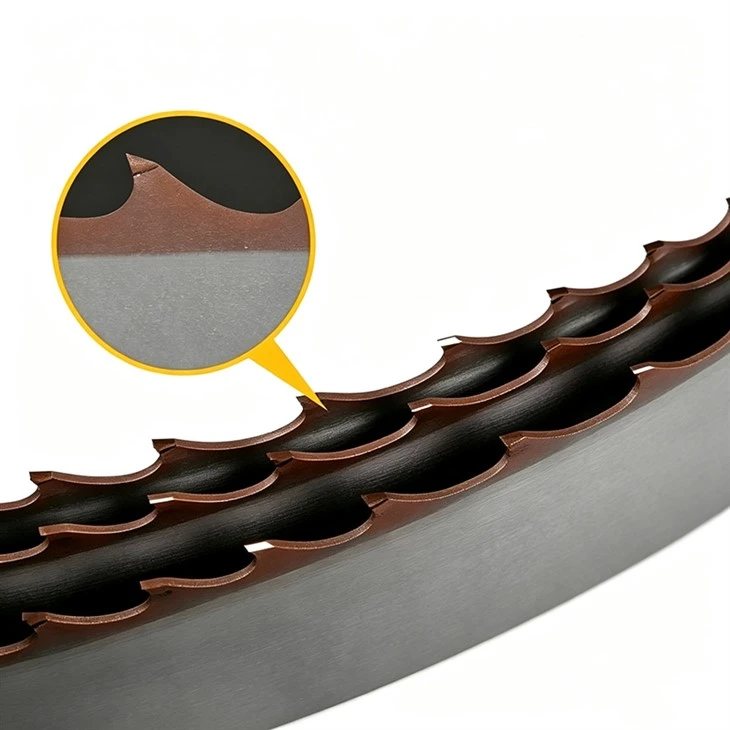
M42 (8% Co, HSS-DMo5 edge, approx. HRC 67–69) is the workhorse for mixed fabrication. It handles mild steel, structural sections, tool steel, and stainless up to roughly 45 HRC at a cost point that makes sense for general-purpose sawing. If your customers cut a broad mix of solids, tubes, and profiles, M42 coil is the default stock-keeping unit for a distributor's shelf.
M51 (10% Co, higher V and C, approx. HRC 68–70) earns its premium where M42 dulls too quickly to be economical. Stainless tube and pipe running every shift, high-nickel alloys, and work-hardening grades are where M51's extra wear resistance translates into fewer blade changes and less downtime. The trade-off is cost per meter and slightly different break-in behavior - M51 rewards a disciplined feed schedule and punishes operators who "push it like an M42".
A practical rule for coil stockists: keep M42 in the widths and pitches that move weekly, and stock M51 selectively in the sizes your stainless-heavy accounts call for repeatedly. Carrying M51 across every width "just in case" ties up capital in slow-moving inventory without improving your quote hit rate.
Edge grade comparison
| M42 | M51 | |
| Cobalt content | 8% | 10% |
| Tooth hardness (typical) | HRC 67–69 | HRC 68–70 |
| Sweet spot | Mixed mild steel, structural, tool steel, stainless ≤45 HRC | Stainless tube/pipe, high-nickel alloys, work-hardening grades, larger cross-sections |
| Relative edge life | Baseline | Noticeably longer in abrasive / work-hardening cuts |
| Coil economics | Lower cost per meter; broader shelf coverage | Higher cost per meter; justified by reduced changeover frequency |
Hardness values are typical ranges for bimetal HSS edges; actual performance depends on feed, speed, coolant, and material condition.
Coil Specifications - Width, Thickness, and Pitch
The table below covers the sizes Sipu runs most often in metal cutting band coil. If your required width/thickness/pitch combination sits outside this matrix, send the spec - custom coil is a standard request, not an exception.
| Width (mm) | Width (inch, approx.) | Thickness (mm) | Variable pitch options (TPI) | Typical coil length |
| 13 | 1/2" | 0.65 / 0.90 | 6/10, 8/12, 10/14 | 100 m / 200 m |
| 19 | 3/4" | 0.90 | 4/6, 5/8, 6/10, 8/12 | 100 m / 200 m |
| 27 | 1" | 0.90 | 2/3, 3/4, 4/6, 5/8, 6/10, 8/12 | 100 m |
| 34 | 1-1/4" | 1.10 | 2/3, 3/4, 4/6, 5/8 | 85–100 m |
| 41 | 1-1/2" | 1.30 | 1.4/2, 2/3, 3/4, 4/6 | 85 m |
| 54 | 2" | 1.60 | 1.4/2, 2/3, 3/4, 4/6 | 80–100 m |
A note on pitch selection for coil buyers: variable pitch is the default for production metal cutting because it breaks resonance and reduces the chatter that accelerates tooth wear. For thin-wall tube and small solids, finer variable pitches (8/12, 10/14) keep more teeth engaged and reduce tooth stripping. For large solids and thick sections, coarser pitches (2/3, 3/4) provide the gullet capacity to clear chips. The common distributor mistake is stocking too many fine pitches and too few coarse ones - solids move, but they need gullet depth, not tooth count.
The Weld Question - What Coil Supply Actually Requires of You
Coil is only cheaper if the weld is reliable. A poorly joined coil produces a blade that fails at the seam, and a seam failure in a customer's saw is a warranty conversation you do not want.
Sipu coil is supplied unwelded, oiled, and protected. The weld is performed by the distributor or end user. This means your weld process - strip preparation, alignment, annealing/tempering, and grinding - is the variable that determines whether the coil performs like a finished loop. For buyers with an established weld station, this is routine. For buyers newer to coil, the practical sequence is: square-cut the strip, clean the oxide, align tooth pitch across the joint, weld (flash-butt or laser), temper the weld zone, and grind the weld flush without overheating the tooth edge.
If you are not set up for in-house welding, Sipu also supplies pre-welded loops to your length, so you can split your purchasing between coil for high-runner sizes and loops for low-volume or odd-length requirements without maintaining a weld line.
A practical sourcing split: coil for the two or three widths that account for the majority of your metal-cutting volume; welded loops for the long-tail sizes and for accounts that cannot weld in-house. This keeps your inventory lean without forcing every customer into a coil-only buying pattern.
Packaging, Coil Length, and Export Protection
Metal cutting band coil is a rust-sensitive product. A coil that arrives with surface oxidation on the back edge or between wraps creates problems at the weld station and invites complaints that have nothing to do with tooth quality.
Sipu's standard export packing for coil: light anti-rust oil on the strip, VCI paper or film wrap, and a reinforced carton or plywood case depending on coil weight and destination. Coil lengths are confirmed per order - 100 m and 200 m are standard for most widths, with shorter or longer put-ups available on request. The objective is 60+ days of ocean transit without rust or edge damage.
For distributors who private-label, we can apply neutral packing or your labeling to the coil wrap and case. Laser marking on the strip itself is available for bulk coil orders where brand visibility at the saw matters to your accounts.
FAQ
Q: What is the difference between "coil stock" and a "welded loop" when I place an order?
A: Coil stock arrives as a continuous length of blade, oiled and protected, with no weld. You cut it to length and weld it yourself. A welded loop arrives as a finished, joined blade sized to your machine. The tooth geometry and edge grade are the same; the difference is who performs the weld and carries the weld-quality risk.
Q: How do I decide between M42 and M51 for a customer who cuts both mild steel and stainless?
A: Start with the mix. If stainless is occasional and mostly thin-wall or small solid, M42 covers it without overpaying. If stainless runs regularly or the sections are large enough that work-hardening becomes a feed-control problem, M51's extra wear resistance pays back in fewer mid-shift blade changes. A distributor can stock M42 broadly and M51 in the two or three sizes the stainless accounts actually call for.
Q: Can you supply coil in a length other than 100 m or 200 m?
A: Yes. Coil length is confirmed per order. Shorter put-ups are common for trial orders or for widths where a full 100 m coil exceeds a customer's usage rate. Longer continuous lengths are possible for high-volume accounts, subject to packing and handling limits.
Q: What documentation comes with a coil shipment?
A: Standard shipment includes packing list, coil dimensions, edge grade, pitch, and quantity. Mill certificates and batch traceability documentation are available on request for accounts that require incoming material verification.
Q: How should coil be stored before welding?
A: Keep it dry, off concrete floors, and in the original VCI wrap until the weld station is ready. A coil left unwrapped in a humid shop will surface-rust at the edges long before the teeth are affected - and surface rust at the weld zone is a common cause of seam failure that gets misattributed to the blade.
Hot Tags: metal cutting band coil, China metal cutting band coil manufacturers, suppliers, factory, bandsaw blade for metal profiles, carbide tipped bandsaw blade, metal bandsaw blade for profiles, skip tooth metal bandsaw blade, tungsten bandsaw blade, variable tooth pitch metal bandsaw blade