




Product Introduction
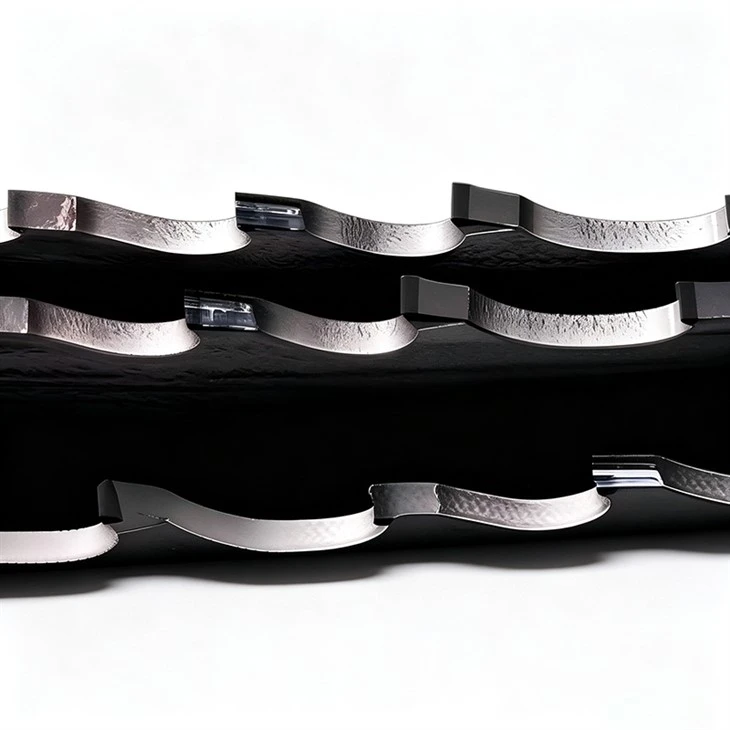
The tooth strip is M42 (8% Co, 10% Mo) at 67–69 HRC, or M51 (10% Co, 10% Mo) at 68–70 HRC. The backing is a chromium-alloyed spring steel selected for fatigue resistance under cyclic bending. M42 covers structural steel, carbon steel, and general stainless; M51 is specified where abrasion resistance matters more than initial cost - stainless 304/316, high-nickel alloys, and tool steels above 35 HRC. Tooth geometry is ground after heat treatment, not before, so the final edge geometry is cut into hardened material.

Technical Specifications
| Width | Thickness | Variable TPI | Constant TPI (selected) | Application focus |
| 13 mm | 0.65 / 0.90 mm | 6/10, 8/12, 10/14 | 4, 10, 14, 18 | Tube, small solids, thin wall |
| 20 mm | 0.90 mm | 4/6, 5/8, 6/10, 8/12 | 4, 8, 10, 14 | General fabrication |
| 27 mm | 0.90 mm | 2/3, 3/4, 4/6, 5/8 | 4, 8, 10, 14 | Structural, bundle cutting |
| 34 mm | 1.10 mm | 2/3, 3/4, 4/6, 5/8 | 4 | Medium solids, profiles |
| 41 mm | 1.30 mm | 1.4/2, 2/3, 3/4, 4/6 | 4 | Large sections, stainless |
| 54 mm | 1.60 mm | 1.4/2, 2/3, 3/4, 4/6 | - | Heavy solids, billet |
Widths and thicknesses outside this table are produced to order. Hook angle is set to the tooth pitch and the buyer's material mix; standard production uses positive rake with a deep gullet for chip clearance on solids, and a shallower gullet for tube and profile where tooth stripping is the failure mode.
Weld Integrity
Loops are closed by flash butt welding, followed by a tempering cycle across the joint. Published tensile data on flash-butt welded bandsaw joints puts ultimate strength at 80–90% of the base material - the joint is the mechanical limit of any welded loop, and tempering is what keeps it from becoming the first failure point. Every loop is bend-tested before packing. If a weld separates before the teeth show wear, the loop is replaced.
Variable Pitch and Noise
Variable-pitch sequences (2/3, 3/4, 4/6, 5/8, 6/10, 8/12, 10/14) interrupt the tooth-entry frequency that excites resonance in the workpiece and the band. In side-by-side cutting tests on comparable band saws, variable-pitch geometry has measured 8–14 dB lower sound pressure than constant-pitch blades of the same width. The same pitch variation reduces harmonic vibration at the guide arms, which is where most "snaking" cuts originate. Thin-wall tube and structural section cutting benefits most from the finer variable pitches (8/12, 10/14) because tooth load stays distributed across two or three teeth rather than concentrating on one.
TiAlN Coating (Optional)
A 1–2 µm TiAlN layer applied by PVD raises surface hardness and lowers friction at the tooth-chip interface. In controlled band saw tests, coated bands have run at feed rates roughly 50% above uncoated equivalents while holding the same surface finish, with the largest gains on stainless and alloy steel where built-up edge is otherwise a problem. Coating is specified when the buyer's cutting mix includes austenitic stainless or high-nickel alloys; for mild steel and aluminum, uncoated M42 usually gives the better cost-per-cut.
FAQ
Q: How do I decide between M42 and M51 for a stainless-cutting customer?
A: M42 (8% Co) is the default for 304/316 stainless up to moderate section sizes. M51 (10% Co) is specified when the customer is cutting high-nickel alloys, duplex stainless, or hardened tool steel above 35 HRC, or when M42 life is coming up short on abrasive work-hardening grades. The price gap is real; M51 is not a blanket upgrade for mild steel.
Q: What weld strength can you document?
A: Flash-butt welded joints in bandsaw strip measure 80–90% of base-metal tensile strength in published testing. Every loop is bend-tested before packing. The practical failure mode on a correctly tensioned saw is tooth wear, not weld separation. If a weld opens before the teeth dull, the loop is replaced under warranty.
Q: Can you supply coils instead of finished loops?
A: Yes. Coils run 100 m or 200 m, packed on a spool or in a figure-eight coil depending on width. Coil supply is intended for distributors who weld on their own butt welders and want to avoid freight cost on finished loops. Tooth pitch and width are fixed at the coil level, so the distributor's welding scope is limited to loop length.
Q: What is the realistic lead time on a mixed order of 30 loops in three different lengths?
A: Standard widths and pitches are cut and welded from stock strip within 48 hours. Three non-standard lengths on the same order add one day for setup and welding; the 48-hour window holds if the lengths fall within the normal range for that width. Orders above 200 loops move to a 7–14 day schedule because the tooth-welding line is batched by tooth material grade.
Q: Does TiAlN coating change the break-in procedure?
A: Coated bands do not require the 50% feed-rate break-in used on uncoated M42. The coating is already at full hardness, and the tooth edge has been ground after coating. Start at the recommended feed for the material and monitor chip color; if chips turn blue, reduce speed rather than feed.
Hot Tags: high speed steel band, China high speed steel band manufacturers, suppliers, factory, bandsaw blade for aluminum, bandsaw blade for angle cutting, bandsaw blade for metal tubing, bandsaw blade for sheet metal, Quality Bandsaw Blades, skip tooth bandsaw blade


