


Product Introduction
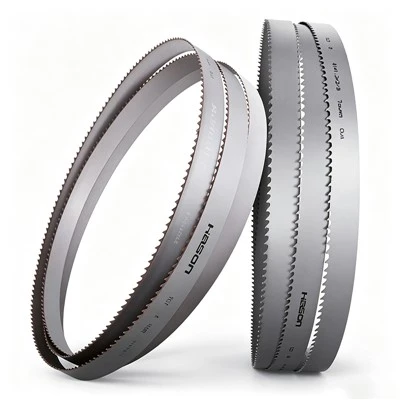
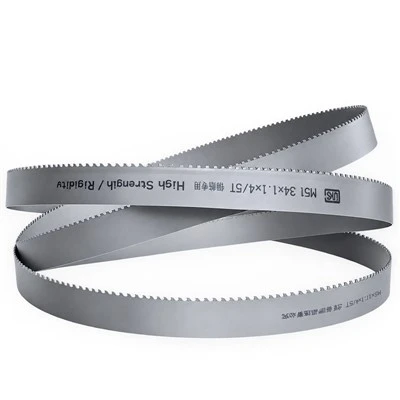
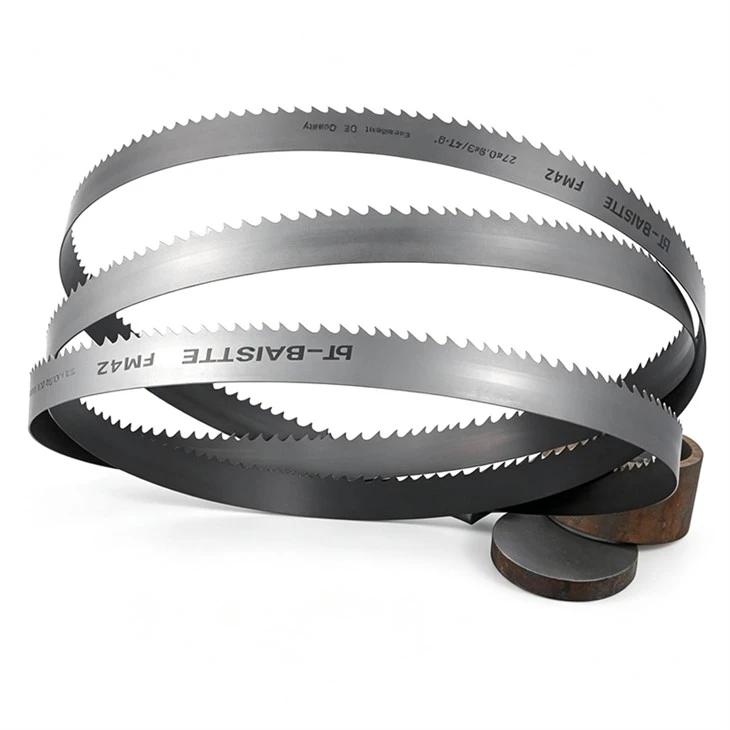
Aluminium and copper do not behave like steel. The chips are soft, long and sticky. A tooth form that works on 1045 steel will load up and rub on 6061 extrusion. That is why we build this non-ferrous bandsaw blade line around chip flow first, then hardness. M42 bimetal covers the bulk of aluminium, copper, brass and bronze work. M51 is there for mixed-floor shops that also run stainless. TCT is held back for abrasive non-ferrous stock - castings, remelt with sand, hard inclusions - where a bimetal edge would be worn out before the job is finished.

Tooth geometry and gullet: the part that decides whether the cut runs clean
The teeth on these blades are ground with a positive rake. The edge leans forward and shears the material instead of scraping across it. This matters on aluminium because a scraping action generates heat at the tooth tip, and hot aluminium sticks. Once a chip welds to the tooth face, the blade stops cutting and starts rubbing. The deep gullet behind each tooth gives that soft, stringy chip somewhere to go. On a long extrusion run, the difference between a clearing gullet and a shallow one is the difference between a straight cut and a mid-cut stall.
Variable pitch is standard on the mixed-profile sizes. When a job jumps between tube, solid and extrusion in the same bundle, a vari-pitch tooth spacing breaks up the harmonic that builds at a fixed pitch. The blade stays quieter and the tooth corners do not chip out on the section changes.
Backing steel and weld: where a wholesale blade either holds or fails
The backing is a spring-steel strip selected for fatigue resistance, not just tensile strength. Non-ferrous cutting often runs at higher band speeds than steel - bimetal in aluminium commonly sits in the 3,000–5,000 SFPM range - and the back is flexing over the wheels at that speed for the whole shift. A backing that is too hard will take the tooth edge with it when it fatigues.
The weld is treated as a separate quality point, not a finishing step. Each loop is welded to the length you specify, then the weld zone is tempered so the heat-affected area does not become the weak link. If a wholesale customer fits ten blades to ten machines and one weld fails early, that is a return and a phone call. The weld spec exists to keep that number at zero.
Specification table
Use this table by cross-section type, not by a single "thickness" number. Aluminium is often pitched one step coarser than steel at the same section because the chip volume is larger.
| Width (mm) | Backing thickness (mm) | Tooth pitch (TPI, vari) | Typical non-ferrous application |
| 13 | 0.65 / 0.90 | 8/12, 10/14 | Thin-wall aluminium tube, small copper profiles, ≤6 mm wall |
| 16 | 0.90 | 6/10, 8/12 | Aluminium extrusion, copper bar up to ~30 mm |
| 19 | 0.90 / 1.07 | 5/8, 6/10 | General aluminium solid 12–50 mm, brass bar |
| 27 | 0.90 / 1.07 | 4/6, 5/8 | Aluminium billet, thick copper and bronze solid |
| 34 | 1.07 | 3/4, 4/6 | Large aluminium ingot, cast non-ferrous stock over 50 mm |
| 41 | 1.27 | 3/4, 2/3 | Heavy non-ferrous billet and slab |
Tooth material options: M42 (HSS-Co8, tooth hardness HRC 67–69) / M51 (higher V and Co, for mixed stainless + non-ferrous floors) / TCT (carbide tip, for abrasive cast and remelt non-ferrous).
Welded loop or coil: loops cut and welded to your machine length; coils supplied for distributors with in-house welding.
What this blade is matched to - and what it is not
This non-ferrous metal saw blade is matched to aluminium extrusions, 6061/7075 solids, copper and brass bar, bronze, and mixed non-ferrous bundles where wall thickness changes within the same cut. It is not positioned as a stainless or titanium blade. M51 will run stainless if the shop needs one blade for a mixed floor, but on a pure aluminium/copper line M42 does the same cut at a lower blade cost. TCT is reserved for stock that eats bimetal edges - sand-cast aluminium, hard-particle remelt, abrasive non-ferrous castings - where the higher blade price is earned back by the metres cut before a change.
Wholesale supply and packaging
Welded loops are made to the length or machine model you specify. Standard production runs ship in 7–14 working days; stock sizes can move faster.
Mixed specification orders - different widths, pitches and tooth materials in one shipment - are consolidated under one packing list. This is the normal wholesale order shape, not an exception.
Anti-rust protection for export: each blade is oiled and VCI-wrapped, then packed in reinforced cartons or plywood crates rated for 60+ days sea transit. Packaging spec can be adjusted for destination humidity.
Laser marking and packaging OEM available from defined batch quantities. Marking can start at a lower threshold than full custom cartons; ask for the breakpoints before quoting your customer.
FAQ
Q: What happens if a weld fails?
A: We distinguish early weld failure under normal band tension and speed from breakage caused by parameter misuse or foreign material in the cut. For the former, we replace the affected blades within the agreed batch window. For the latter, we provide a cutting-parameter review rather than a no-questions replacement, because a repeat failure on the same machine usually points to tension, guide alignment or feed rate, not the loop itself.
Q: Do you supply coils or welded loops - and what if my customers use different machine brands?
A: Both. Welded loops are cut to your customer's machine length or model. Coils are for distributors who weld in-house and want to control the final length. Tell us the machine list at quotation stage; mixed-brand orders are welded and labelled by machine reference before packing.
Q: M42 or TCT for aluminium and copper - and can I mix them in one order?
A: M42 is the default for clean aluminium, copper, brass and bronze. TCT is the right call when the incoming stock is abrasive - sand-cast, remelt, or hard-particle non-ferrous. Mixed M42/TCT orders are consolidated under one packing list. If you are unsure which way a particular end-user should go, send the material spec and section; we will give a selection recommendation, not just a price.
Q: What is the starting quantity, and how do samples work?
A: Starting quantities differ between welded loops and coils because the welding and packing steps are different. Sample orders are priced as samples, not as free stock, and the sample cost can be credited against the first production order under the agreed terms. Ask for the current breakpoints for your destination.
Q: Can we put our brand on the blade and the packaging?
A: Laser marking of your brand, part number and tooth spec can start at a lower batch quantity than full custom packaging. Printed cartons, neutral boxes and OEM labels have a higher per-SKU threshold because of the print and packing setup. We will separate the two thresholds in the quotation so you can phase the branding rather than buying a full container of packaging before the blade sells.
Hot Tags: non-ferrous metal saw blade, China non-ferrous metal saw blade manufacturers, suppliers, factory, bandsaw blade for aluminum, carbide tipped bandsaw blade, metal bandsaw blade, metal bandsaw blade for profiles, metal cutting bandsaw blade, narrow metal bandsaw blade