


Product Introduction
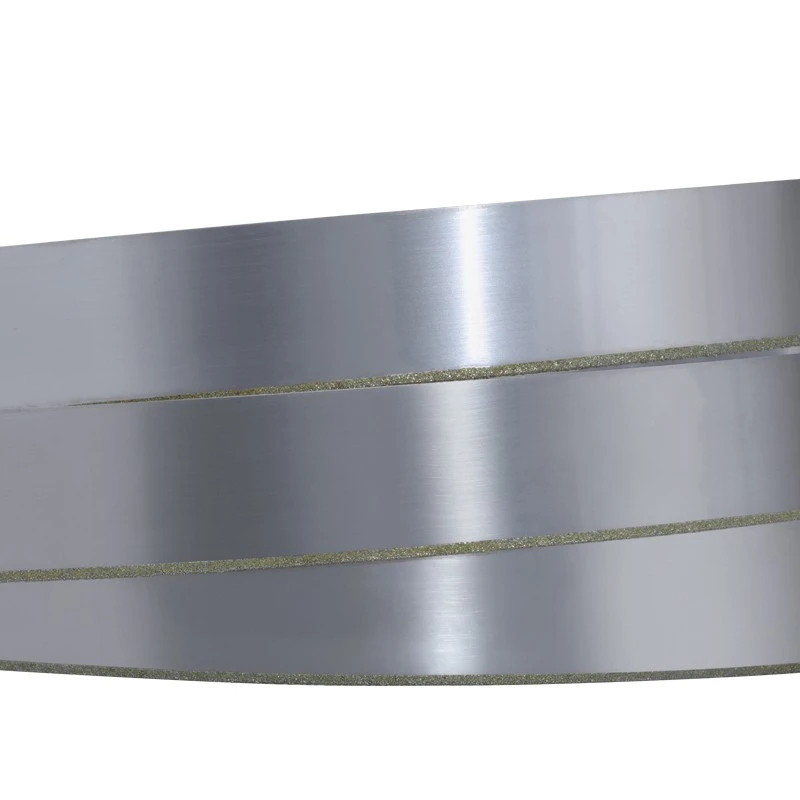
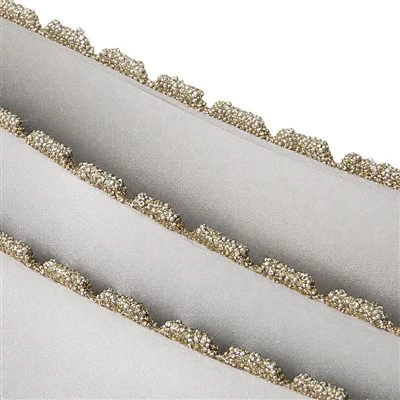
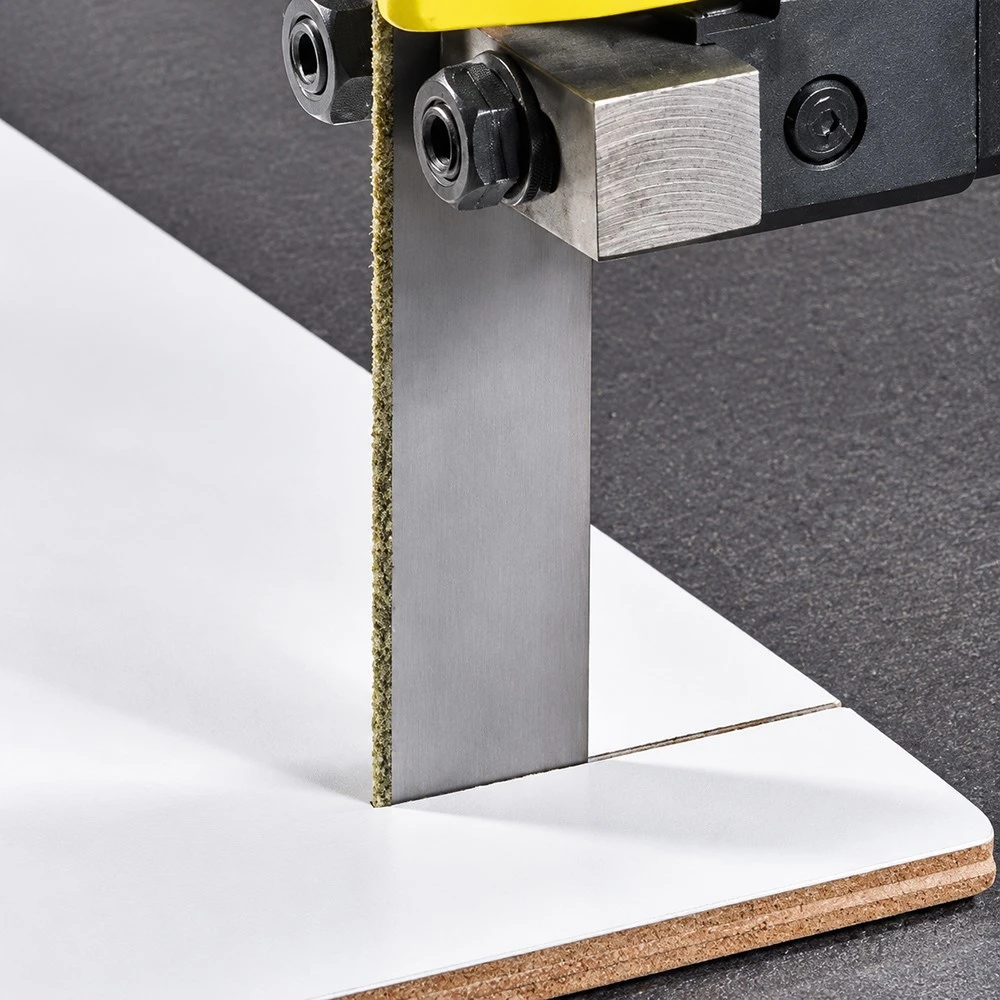
Electroplated diamond band saw blade for cropping monocrystalline silicon ingots and squaring blocks. The blade runs on standard silicon cropping machines with a wet cutting circuit, removing material by grinding action rather than toothed impact. This keeps subsurface micro-crack depth controlled and produces a cut face that requires minimal stock removal before wafering or subsequent processing.
Specification
| Parameter | Value |
|---|---|
| Backing material | High-tensile stainless steel strip |
| Width | 38 mm standard for silicon cropping; 10–80 mm available on request |
| Backing thickness | 0.40 mm / 0.60 mm / 0.70 mm |
| Diamond grit | 80/100, 100/120 standard for monocrystalline silicon; 35/40 and 50/60 available for coarser requirements |
| Edge profile | Continuous diamond coating (segmented profile available for larger section blocks) |
| Weld type | Flash-butt welded loop, annealed at the weld zone |
| Loop length | Welded to machine requirement; common lengths include 3230 mm, 3750 mm, 4550 mm, 4900 mm |
| Recommended band speed | 1,000–1,500 m/min (electroplated diamond band) |
| Recommended feed rate | 5–50 mm/min, adjusted to ingot diameter and surface requirement |
| Coolant | Water-based coolant required; flood delivery at the cut zone |
Blade width and thickness are not independent variables. A 0.40 mm backing with 38 mm width is used where kerf loss and surface finish carry more weight than beam stiffness. A 0.60–0.70 mm backing is specified for larger diameter ingots or where the machine's tension system and wheel diameter support a heavier band. Kerf width on a continuous-edge blade is determined by backing thickness plus the diamond layer on both sides; on a 0.40 mm backing, the diamond coating contributes approximately 0.6–1.5 mm to the total cut width depending on grit size.
Cutting behavior on monocrystalline silicon
Monocrystalline silicon fractures directionally. A toothed blade concentrates stress at the tooth tip and produces chipping along the {111} cleavage planes. An electroplated diamond edge distributes the load across a continuous layer of abrasive particles, so material is removed by micro-grinding rather than by a single-point load. Feed rate and band speed are set against each other: higher band speed with lower ingot feed reduces surface roughness and subsurface damage, while lower band speed with moderate feed improves flatness and reduces wafer warp tendency. For a 6-inch silicon rod cut on a cropping machine with a 0.7 mm edge thickness, a cross-section flatness of 0.2 mm and surface roughness Ra 2.0 μm are achievable with a properly tensioned blade and stable coolant delivery. Tighter surface finish - Ra ≤ 1.6 μm on continuous-edge profiles - is possible on smaller sections and with finer grit selection, though the actual value depends on the machine's rigidity and the operator's parameter window.
The blade does not correct for poor machine setup. Tension must be held within the band manufacturer's range - typically 100–200 N/mm² for electroplated diamond band - and the wheels must be dressed and aligned before a new blade is run in. A tension deviation of 10% across the band length is enough to produce a tapered cut on a 200 mm ingot. Sipu welds each loop, anneals the weld zone, and checks weld straightness before coiling; the weld is the first location to inspect if a mid-cut deviation appears.
Manufacturing and quality control
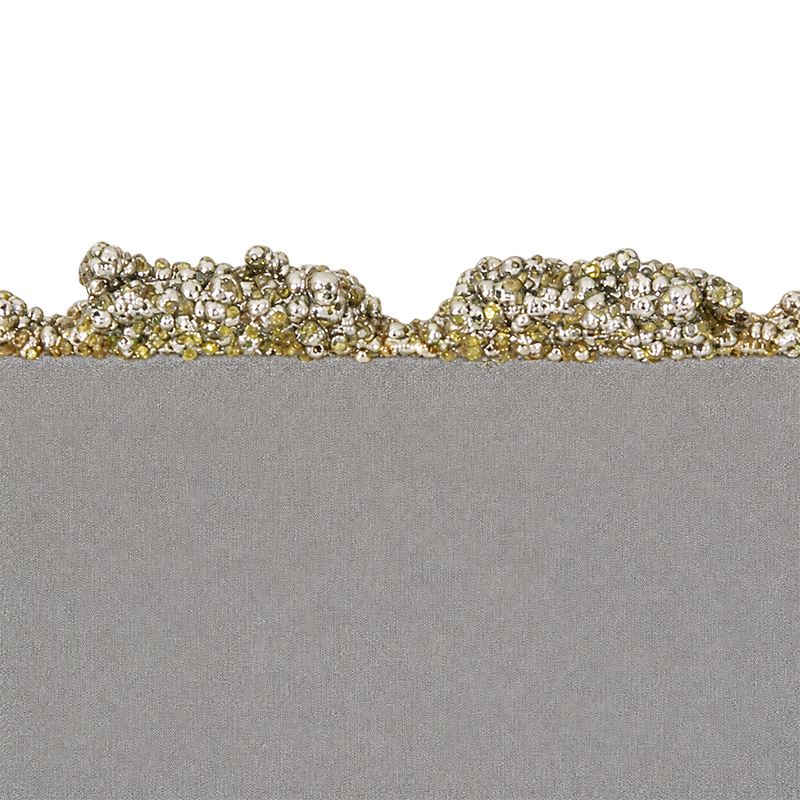
The stainless steel backing is selected for fatigue resistance under reverse bending over the machine wheels. Each loop is welded to length, then the weld is annealed and ground flush so the diamond coating sits at a uniform height across the joint. The electroplating bath deposits a single layer of diamond grit with controlled particle density; grit size and coating thickness are matched to the application. For monocrystalline silicon cropping, the continuous edge is preferred over a segmented edge because the uninterrupted abrasive layer reduces edge chipping at the exit side of the cut.
Incoming strip is checked for thickness tolerance and tensile properties before plating. Finished loops are measured for width, backing thickness, weld offset, and diamond layer integrity. Each shipment can be supplied with a dimensional inspection record and material certificate. Sipu holds a production tolerance of ±0.05 mm on backing thickness for silicon-grade loops; loops outside this tolerance are rejected before packing.
Customization
Loops are welded to the length required by the customer's cropping machine, not limited to the common 3230 mm or 4900 mm sizes. Widths from 10 mm to 80 mm are available, with 38 mm as the standard for monocrystalline silicon ingot cropping. Grit size can be specified from 35/40 through 100/120 depending on whether the priority is cut rate or surface finish. For distributors who weld their own loops, the blade can be supplied in open-length coils with the diamond edge protected by a removable guard. Laser marking of brand name and part number is available on the backing; the marking is placed outside the cutting zone and does not interfere with the diamond coating.
Packaging and delivery
Each welded loop is coiled with the diamond edge protected, wrapped in VCI paper, and sealed in a moisture-barrier bag. Coils are packed in reinforced plywood cases for sea freight. Standard silicon-grade sizes ship from stock within 48 hours where the loop length matches a stocked specification; custom lengths and non-standard grit sizes are quoted at 7–14 working days from drawing approval. Sample loops for machine trials are available before a production order.
FAQ
What distinguishes a monocrystalline silicon blade from a general-purpose diamond band saw blade?
The backing thickness and grit selection are narrower. Monocrystalline silicon cropping uses a continuous diamond edge on a 0.40–0.70 mm stainless backing, with grit sized to balance cut rate against micro-crack depth. A general-purpose diamond band may use a segmented edge and a thicker backing for mixed materials such as glass, ceramic, or graphite, where kerf loss is less critical and edge impact loads are higher.
Can the blade be supplied as an open coil rather than a welded loop?
Yes. Open-length coils are available for distributors who operate their own welding equipment. The diamond edge is protected with a removable strip during coiling and transport. Coil lengths are quoted against the customer's required number of loops plus welding allowance.
What information is needed to quote a loop for a specific cropping machine?
Loop length, band width, backing thickness, diamond grit, and the machine's recommended band speed and tension range. If the existing blade is worn but unbroken, the overall length and weld position are sufficient to duplicate the loop. For new machine setups, the wheel diameter and the maximum ingot diameter determine whether a 0.40 mm or 0.60–0.70 mm backing is appropriate.
How is the weld quality verified before shipment?
Each welded loop is visually inspected for weld offset and coating continuity across the joint. The weld zone is annealed to restore backing ductility, and the loop is run over a check wheel to confirm straightness. A weld that shows misalignment or coating discontinuity is rejected at final inspection and does not enter packing.
What is the minimum order quantity for a silicon-grade loop?
The standard minimum is five loops per specification. Mixed specifications - different lengths or grit sizes within the same width and thickness - can be combined to meet the minimum. Sample loops for trial cutting are available before the first production order.
Hot Tags: monocrystalline silicon saw blade, China monocrystalline silicon saw blade manufacturers, suppliers, factory, continuous rim diamond blade, diamond band saw blade, Diamond Band Saw Blades Glass, diamond bandsaw blade for stone, diamond coated bandsaw blade, diamond grit cutting blade