




Product Introduction
Electroplated diamond grit on a stainless steel backing, supplied as welded loops or coil stock for stationary and bridge-type stone band saws.
Blade Construction
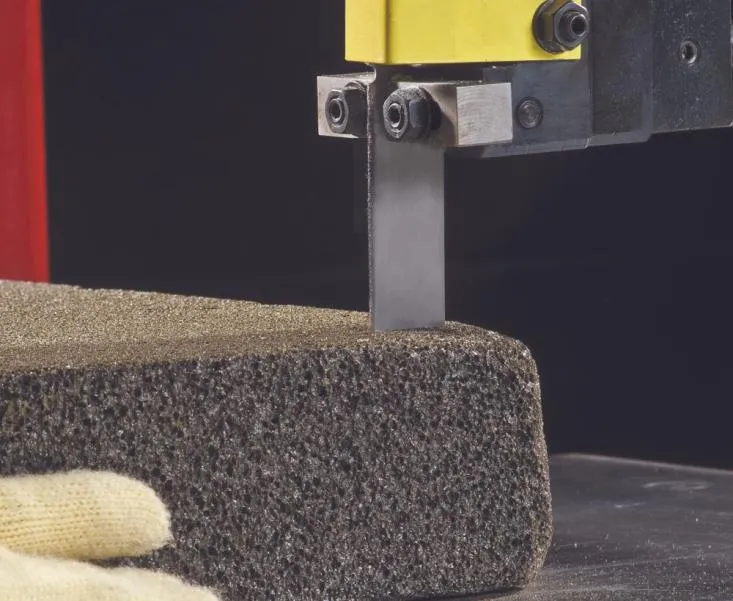
The cutting edge is electroplated diamond grit, mechanically locked into a nickel layer on a high-tensile stainless steel band. Diamond sits at approximately 9.5 on the Mohs scale-above quartz and most granite-forming minerals-so the blade removes material by grinding rather than by toothed shearing. The stainless backing is specified where water cooling is in continuous use: the chromium-bearing surface forms a passive film that limits oxidation along the band and at the weld zone under wet cutting conditions.
Two edge patterns are available. Continuous rim carries diamond across the full cutting edge and is suited to section thicknesses up to 25 mm, where edge stability and surface finish take priority over chip clearance. Segmented rim leaves gullets between diamond-bearing segments; it is specified for larger blocks and for cuts where slurry and granite fines must clear the kerf rather than recirculate under the band.
Specifications
| Parameter | Range | Selection note |
|---|---|---|
| Width | 10–80 mm | Narrow widths for contour and slab edging; wider bands for block squaring and straight slicing |
| Thickness | 0.50 mm / 1.00 mm (standard) | 0.50 mm for lower kerf loss and reduced drive load; 1.00 mm for heavier block sections and higher feed pressure |
| Diamond grit | 35/40, 50/60 | Coarser grit for faster stock removal in rough slicing; finer grit for reduced sub-surface damage and tighter edge chipping control |
| Edge pattern | Continuous / Segmented | Continuous: ≤25 mm section. Segmented: larger granite blocks and cuts requiring active slurry evacuation |
| Backing | High-tensile stainless steel | Specified for wet cutting and coolant recirculation environments |
| Supply form | Welded loop or coil | Welded to machine center-to-center length; coil stock supplied for in-house welding |
| MOQ | 5 blades | Welded loops; coil quantity quoted separately |
Width and thickness combinations outside this table are produced to drawing. Provide the machine's wheel diameter, center-to-center length and the section thickness range of the work; the band gauge and edge pattern are then matched to the drive load and kerf allowance of that saw.
Wet Cutting and Band Speed
Granite is cut wet. Water or coolant is directed at the point of contact to control the temperature at the diamond–nickel bond and to carry granite fines away from the kerf. Dry running shortens bond life and risks heat checking in the workpiece.
For electroplated diamond band on granite, band speed is normally held in the 1,400–1,800 m/min range. Above this window, bond wear accelerates; below it, the diamond does not self-sharpen efficiently and the band begins to rub rather than grind. Feed rate is set against section thickness and grit size: a 50/60 grit continuous-rim band on 20 mm granite will tolerate a higher feed per pass than a 35/40 segmented band on a 300 mm block, where the limiting factor becomes gullet clearance and slurry evacuation rather than diamond sharpness.
Weld and Band Integrity
Each welded loop is joined by a butt weld and inspected before packing. Weld quality is checked by tensile pull to a minimum of 1,200 MPa on sampled loops from the same production lot, with dye-penetrant inspection at the weld seam. Backing thickness is held to ±0.02 mm across the band; variation beyond this causes tracking drift on band saws running at stone-cutting tensions.
The backing is stainless, not a coated carbon strip. Under continuous water cooling, a carbon backing will show rust bloom at the weld and along the back edge within a shift, particularly if the machine sits idle between cuts. The stainless substrate removes that failure mode from the maintenance schedule.
Application Boundaries
Granite, marble, engineered quartz, ceramic, glass, graphite and refractory brick are within scope. The blade is not for steel or ferrous alloys. Diamond grit does not cut steel efficiently at band-saw surface speeds; the nickel bond smears and the backing work-hardens the chip rather than clearing it. If a job mixes granite with steel fixtures or embedded rebar, that section should be cut with a bi-metal or carbide blade before the diamond band is installed.
For granite specifically, the two practical failure modes are edge chipping at the exit side and bond loading on thick sections. Continuous rim addresses chipping where the section is under 25 mm. On blocks above that thickness, segmented rim and a coarser grit keep the kerf open; a finer continuous band on a thick block will load with fines before the diamond shows wear.
Packaging and Supply
Loops are coiled, wrapped in VCI paper and sealed before boxing. Coil stock is supplied on a reel with interleaved paper. Both formats are packed for sea freight; the stainless backing is not oil-coated, so no degreasing step is required before installation. Standard grit and edge combinations ship from stock; non-standard widths and welded lengths are quoted with a drawing or machine center-to-center dimension.
FAQ
How do I decide between continuous and segmented edge for a granite job?
Start with section thickness. Continuous rim is specified for granite up to 25 mm, where the uninterrupted diamond edge produces a cleaner exit and less chipping. Above 25 mm, segmented rim is the default: the gaps between segments give slurry somewhere to go, and the band runs cooler on block work. If a shop cuts both thin slabs and thick blocks on the same saw, two blades are cheaper than one blade run outside its edge pattern.
Can this blade cut steel if the diamond is hard enough?
No. The limitation is not diamond hardness; it is the cutting mechanism. Steel at band-saw speed produces continuous chips that load the nickel bond and work-harden ahead of the grit. Diamond band saws are specified for brittle and non-ferrous materials. Steel sections in a granite shop should be cut on a bi-metal band before the diamond blade goes on the machine.
What water flow and band speed do you recommend for granite?
Flood the cut. Coolant should reach the entry point of the band into the stone, not just the exit. Band speed for electroplated diamond on granite sits in the 1,400–1,800 m/min range; if the band is running below that, increase speed before increasing feed pressure. If the cut starts smoking or the band wanders, check coolant delivery at the guides first, then band tension.
Do you weld loops to a machine's center-to-center length, and what is the minimum order?
Yes. Welded loops are made to the center-to-center dimension supplied with the order. Minimum order is 5 welded blades for standard grit and edge combinations. Coil stock for shops that weld in-house is quoted by meter; provide the band width, thickness and grit, and the coil is supplied on a returnable or non-returnable reel according to destination.
Is the backing carbon steel or stainless?
Stainless. The band is specified as high-tensile stainless steel because granite cutting runs wet. A carbon backing would need a post-cut oil wipe at every stop and would still show rust at the weld seam under intermittent use. The stainless substrate is part of the blade specification, not a surface treatment.
Hot Tags: granite slicing saw blade, China granite slicing saw blade manufacturers, suppliers, factory, continuous diamond edge bandsaw blade, continuous rim diamond blade, diamond blade for engineering materials, electroplated diamond bandsaw blade, sintered diamond edge bandsaw blade, wet diamond bandsaw blade


