


Product Introduction
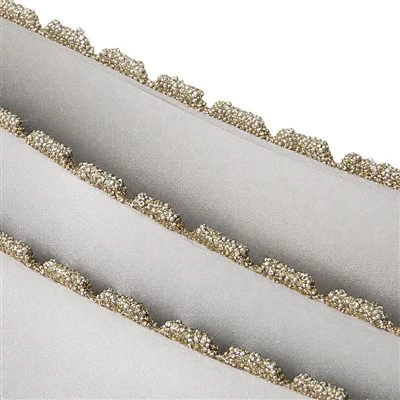
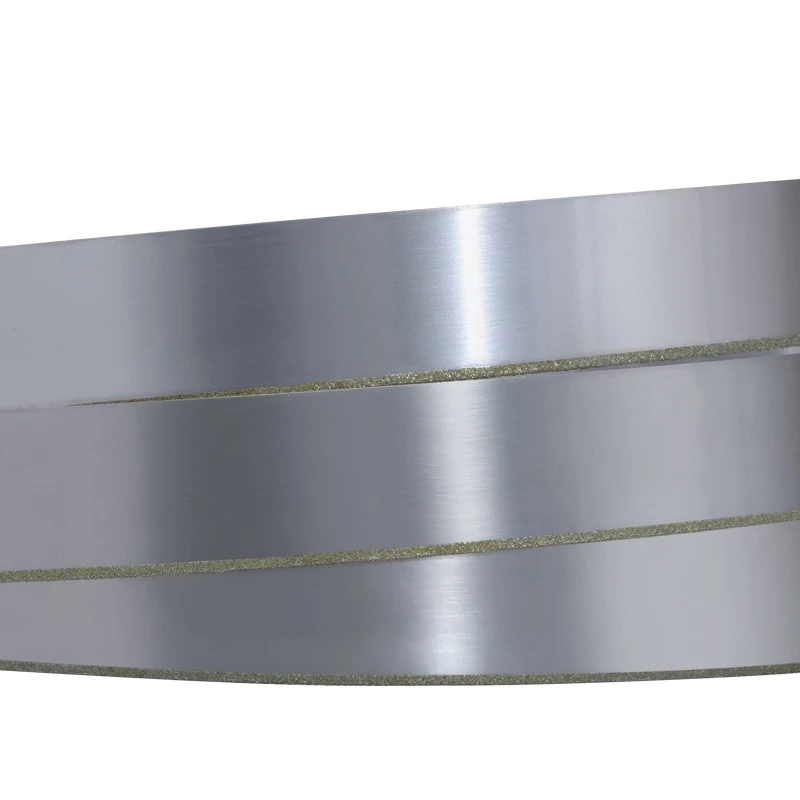
Electroplated diamond grit on a high-tensile steel backing, supplied as welded loops to your machine length. Intended for CFRP, GFRP, aramid honeycomb and sandwich panels where toothed blades cannot hold an edge.
Specification
| Parameter | Data |
|---|---|
| Blade width | 12 mm, 16 mm, 19 mm, 25 mm (standard); 6 mm–40 mm by request |
| Backing thickness | 0.50 mm / 0.65 mm |
| Diamond grit | 60/80 (standard for CFRP); 80/100, 100/120 available |
| Edge configuration | Continuous coating; segmented / castellated for sections above 6 mm |
| Loop length | Welded to customer-specified length |
| Backing material | High-tensile steel strip, spring-tempered |
| Bond | Electroplated nickel matrix |
| Cutting direction | Bi-directional |
| MOQ | 5 loops |
What the grit specification controls
Diamond grit size is not a "finish option" on this blade - it sets the balance between cut rate and edge integrity. For CFRP under 6 mm, a 60/80 or finer continuous coating cuts with minimal fibre pull-out at the kerf edge. Above 6 mm, the same grit in a continuous format loads with resin dust and cuts slowly; the segmented edge opens a clearance path for swarf and keeps the diamond exposed. Sipu supplies both edge types on the same backing thickness, so the change is in the coating geometry, not the blade body.
The nickel electroplating bond holds diamond particles in a single layer. Once the grit dulls, the blade stops cutting rather than gradually losing aggressiveness. In CFRP, that transition is predictable: field data puts diamond-grit bandsaw blade life at 15–30 hours of continuous cutting, against 0.5–1.5 hours for HSS and 3–6 hours for carbide-tipped blades on the same abrasive material.
Backing and weld
The backing strip is a spring-tempered high-tensile steel, not a standard carbon bandsaw body. CFRP cutting runs at band speeds of 600–1,200 m/min, and a backing without fatigue resistance at that speed will work-harden and crack before the diamond layer wears out. Sipu's strip is selected for bending-cycle tolerance at those speeds; the same strip specification is used across the diamond series.
Loops are closed by digital flash-butt welding, with weld misalignment held within 0.02 mm on standard widths. The weld is annealed after joining so the heat-affected zone does not become a hard, crack-prone point under cyclic bending. For narrow loops (12–16 mm), this matters more than on wide metal-cutting blades - the smaller the loop, the tighter the bend radius the weld sees per revolution.
Cutting practice
Two machine-level conditions decide whether a diamond-coated blade delivers its full life on CFRP.
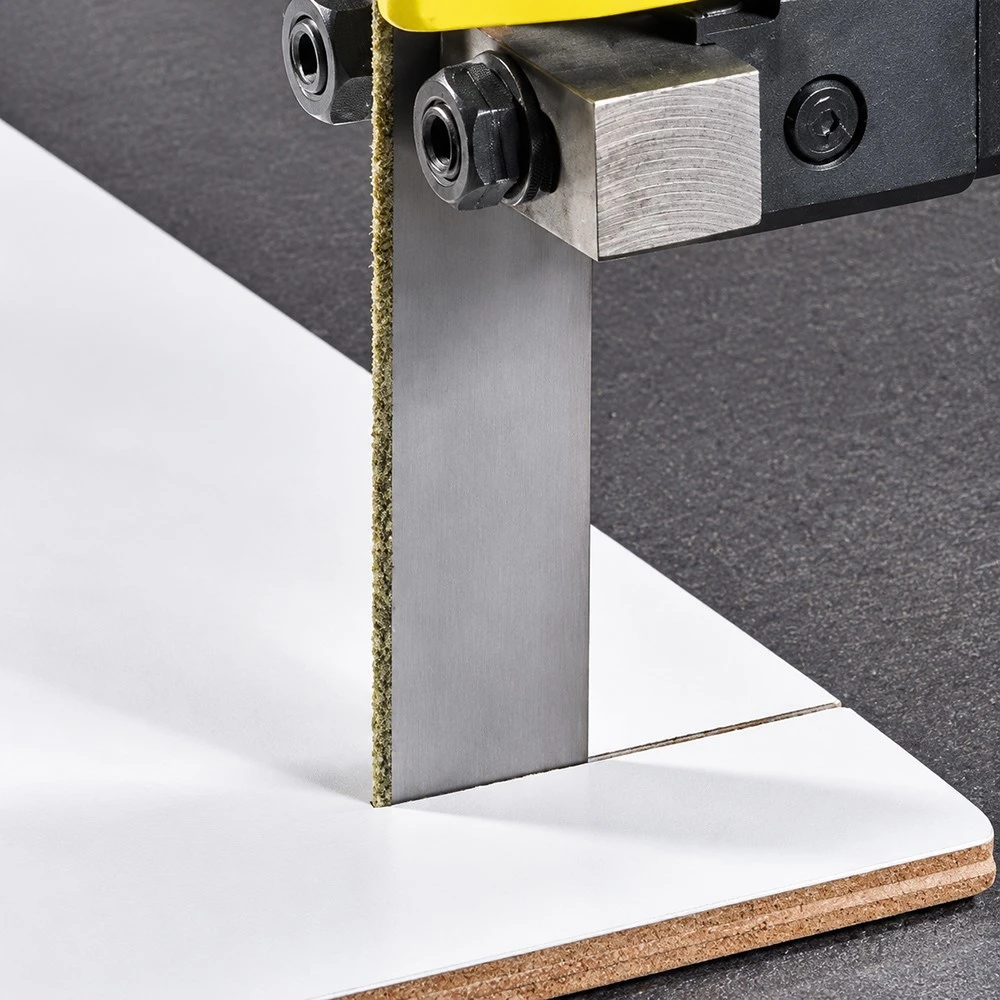
Workholding rigidity. CFRP does not yield; it delaminates when the workpiece moves under cut pressure. The blade edge itself has no teeth to grab material, so any vibration translates directly into fibre breakout at the exit side. A fixture that supports the cut line to within a few millimetres of the blade path is the difference between a clean edge and a frayed one.
Dust and heat management. Dry cutting is possible, but CFRP dust is conductive and abrasive; on continuous production runs, water cooling or integrated extraction keeps the kerf clear and prevents the nickel bond from overheating. A water-miscible coolant at low concentration is sufficient - the goal is dust control and bond cooling, not lubrication.
Cutting speed should be set at the higher end of the machine's range (600–1,200 m/min) with a moderate, steady feed. Forcing feed on a dulling diamond blade generates heat at the bond interface and shortens the remaining grit life faster than reducing feed does.
Machine compatibility and custom lengths
These loops run on standard vertical and horizontal bandsaws fitted with composite-capable guides and, where required, dust extraction. Sipu does not supply the machine; the blade is welded to the length you specify for the machine already on your floor.
Widths 12–25 mm cover most CFRP profile and sheet trimming work. Narrower widths (6–10 mm) are available for tight-radius cuts where the backing can tolerate the bend cycle. Lengths are cut and welded to order; there is no standard length list, because the loop must match the machine's wheel diameter and tension range.
Packaging and export
Each loop is coiled, coated with a rust-preventive film on the backing (the diamond edge is left uncoated to avoid loading the grit), and wrapped in VCI paper. Loops ship in reinforced plywood crates or heavy-duty cartons, depending on order volume. Standard specification orders leave the warehouse within 48 hours where backing and grit are in stock; custom widths and non-standard grit sizes run 7–14 working days. Sipu's export packing is specified for 60+ days of sea freight without backing corrosion.
FAQ
Q: Continuous or segmented edge - which one for my CFRP?
Continuous for sheet and thin sections where edge finish is the priority; segmented or castellated for solid sections thicker than about 6 mm or for nested stacks where dust evacuation controls the cut. If your work mixes both, order the segmented format and run a lower feed on the thin sections - the clearance gaps do not prevent a clean cut when the fixture is rigid.
Q: Can this blade cut both CFRP and GFRP?
Yes. Diamond grit is harder than both the carbon and glass fibres. The difference is in wear rate: GFRP is more abrasive on the nickel bond, so grit life is shorter than on CFRP under the same cutting hours. Grit selection (60/80 vs. finer) has more effect on GFRP edge quality than on CFRP.
Q: What loop length information do you need to weld a replacement?
Wheel diameter, the machine's specified blade length from its manual, and the tension setting you run. If the existing loop is still intact, its overall length is the most reliable reference. Sipu welds to the length you provide; the blade is not supplied as an open coil unless requested.
Q: How do you ship the diamond edge without damaging the grit?
The loop is coiled with the diamond edge facing outward and separated by the VCI wrap so the coating does not contact the backing on the adjacent wrap. Crates are lined to prevent metal-to-metal contact. On receipt, uncoil the loop without kinking it - a sharp bend across the backing can crack the strip even if the diamond layer looks intact.
Q: Is water cooling mandatory?
Not for short runs or thin sheet. For continuous cutting of sections above 6 mm, water cooling or high-volume extraction is recommended to prevent the nickel bond from softening and releasing grit prematurely. Dry cutting with no extraction on thick CFRP will shorten blade life and leave conductive dust on the machine.
Hot Tags: carbon fiber bandsaw blade, China carbon fiber bandsaw blade manufacturers, suppliers, factory, 62 Inch Diamond Band Saw Blade, continuous diamond edge bandsaw blade, diamond bandsaw blade for marble, Diamond Grit Bandsaw Blade, Glass Cutting Band Saw Blade, wide diamond bandsaw blade