

Introduction
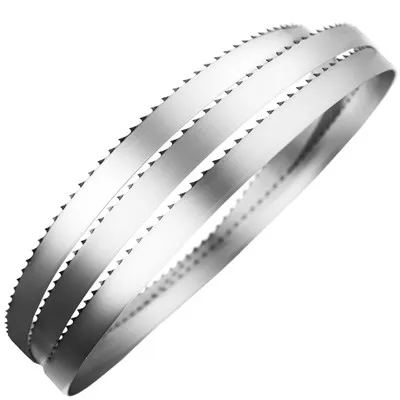
Meat Cutting Band Saw Steel is the base material used to produce continuous bandsaw blades for meat saws, bone saw equipment, and food-processing machinery. For industrial buyers, the quality of the steel strip affects more than cutting sharpness. Strip thickness, hardness, weld integrity, tooth formation, flatness, and tension control all influence how a finished blade performs on the machine.
SIPU supplies food-grade high-carbon steel blade material in standard and customized configurations for commercial meat saws, OEM equipment manufacturers, replacement-blade distributors, and wholesale buyers.

Specification
| Parameter | Specification |
|---|---|
| Material | Food-Grade High Carbon Steel |
| Width Options | 13mm, 16mm, 19mm (5/8", 3/4") |
| Thickness | Standard 0.50mm / 0.56mm |
| Tooth Pitch | 3 TPI, 4 TPI |
| Configuration | Custom Length Welded Loops |
| Compatibility | Suitable for all major commercial bone saw brands and industrial processing lines. |
| MOQ | 30-50 |
Why High-Carbon Steel Is Used
High-carbon steel is widely used in bandsaw blade manufacturing because it can be processed to achieve the combination of hardness and toughness required by a continuous cutting blade.
For a meat saw blade, the material needs to support two different areas of performance.
Tooth Performance
The teeth need sufficient hardness to maintain their cutting profile during operation. If the tooth edge loses its working geometry too quickly, cutting resistance can increase and blade replacement becomes more frequent.
Strip Flexibility
The blade body repeatedly bends around the machine wheels. Excessive brittleness can increase the risk of premature failure, while insufficient hardness may reduce tooth retention.
The material therefore needs to be processed as a complete blade system rather than judged only by a single hardness value.
From Steel Strip to Finished Meat Saw Blade
1. Material Preparation
The steel strip is prepared according to the required blade dimensions before subsequent processing.
2. Welding
The strip is joined into an endless loop. The welded section needs to maintain the required mechanical integrity while passing continuously around the machine wheels.
3. Heat Treatment
Heat treatment establishes the required material condition for the finished blade and its cutting teeth.
4. Tooth Grinding
The teeth are formed and ground according to the specified tooth configuration. Consistency across the blade is important for stable cutting.
5. Tension Correction
The welded loop is checked and corrected so that it can run more consistently on the customer's equipment.
6. Final Inspection
Finished blades can be checked for dimensions, tooth condition, welded-joint quality, hardness, and overall running condition before shipment.
Sipu sawing products are sold both domestically and internationally


FAQ
Q: What type of steel is used for meat bandsaw blades?
A: SIPU's standard configuration uses food-grade high-carbon steel. The material is selected for the combination of hardness and toughness required for continuous blade operation.
Q: Why is high-carbon steel suitable for meat saw blades?
A: High-carbon steel can be processed to provide a suitable balance between tooth hardness and blade-body toughness. This is important because the teeth perform the cutting while the blade body repeatedly bends around the machine wheels.
Q: Does blade thickness affect meat saw performance?
A: Yes. Thickness is part of the overall blade specification and must be compatible with the equipment. SIPU offers standard 0.50 mm and 0.56 mm configurations, with other requirements subject to production confirmation.
Q: Why is the welded joint important in an endless bandsaw blade?
A: The welded joint continuously passes around the machine wheels during operation. Its integrity therefore affects the reliability of the complete loop, not just one small section of the blade.
Q: What information should I provide when requesting a custom meat bandsaw blade?
A: The most useful information includes the machine model, existing blade dimensions, loop length, width, thickness, tooth pitch, and the material being cut. An existing blade or technical drawing can also help with specification confirmation.
Q: Can SIPU supply meat bandsaw blades for private-label brands?
A: Yes. OEM buyers can discuss customized specifications, packaging, and private-label requirements for regular production programs.
Q: How can distributors maintain consistent blade quality between orders?
A: The best approach is to establish a confirmed specification before mass production and use the same dimensions, tooth configuration, and production requirements for subsequent replenishment orders. Sample approval can also be used as a reference for future batches.
Hot Tags: meat cutting band saw steel, China meat cutting band saw steel manufacturers, suppliers, factory, bandsaw blade for butcher shops, bandsaw blade for meat factories, heavy duty meat bandsaw blade, meat bandsaw blade for boneless cuts, Meat Cutting Bandsaw Blade, narrow meat bandsaw blade