

Introduction
Cutting frozen meat puts more resistance on a bandsaw blade than cutting fresh or chilled products. Dense meat blocks, frozen carcasses, and bone-in frozen meat require a blade with an appropriate tooth pitch, stable welded loop, and cutting geometry suited to the material being processed.
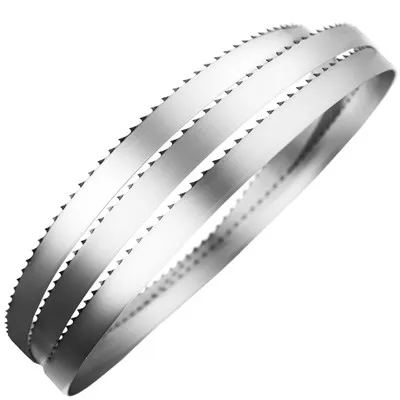
SIPU supplies Frozen Meat Bandsaw Blade for commercial meat saws, food-processing equipment, and industrial cutting lines. Standard configurations are available for different machine sizes, while blade width, thickness, loop length, and tooth pitch can be specified according to the customer's equipment and cutting requirements.

Specification
| Parameter | Specification |
|---|---|
| Material | Food-Grade High Carbon Steel |
| Width Options | 13mm, 16mm, 19mm (5/8", 3/4") |
| Thickness | Standard 0.50mm / 0.56mm |
| Tooth Pitch | 3 TPI, 4 TPI |
| Configuration | Custom Length Welded Loops |
| Compatibility | Suitable for all major commercial bone saw brands and industrial processing lines. |
| MOQ | 30-50 |
Choosing the Right Tooth Pitch for Frozen Meat
Tooth pitch is one of the most important variables when selecting a bandsaw blade for frozen products.
For dense frozen material, 3–4 TPI provides relatively large tooth spacing. This configuration allows the blade to engage with hard material while providing space between teeth for cut material to clear the cutting zone.
The appropriate choice depends on the product condition:
| Cutting Condition | Blade Selection Consideration |
| Deep-frozen meat blocks | Coarser tooth spacing is generally preferred |
| Frozen bone-in meat | Tooth strength and machine compatibility become more important |
| Large frozen carcasses | Consider blade width, loop length and tooth pitch together |
| Semi-thawed meat | A finer tooth arrangement may be suitable |
| Mixed cutting conditions | Confirm the blade against the actual production process |
A blade should therefore be selected according to the actual frozen product being processed, rather than choosing a tooth pitch solely from the machine's available blade size.
Tooth Geometry for Frozen Products
Frozen products require more than a sharp cutting edge.
The tooth profile determines how the blade enters the material, removes the cut material, and continues through the product. SIPU offers configurations using hook and skip tooth profiles for the applications covered by this product range.
The objective is to maintain a workable balance between:
Tooth penetration + material clearance + cutting stability + blade life
For distributors and processors, this balance is particularly important when the same machine operates for extended periods or handles different frozen meat products.
Sipu sawing products are sold both domestically and internationally


FAQ
Q: Is a frozen meat bandsaw blade different from a regular meat bandsaw blade?
A: The basic blade construction can be similar, but the selection should reflect the harder cutting conditions created by frozen products. Tooth pitch, tooth profile, blade dimensions, and machine settings should be considered according to the material being cut.
Q: What TPI is best for frozen meat?
A: There is no single TPI that works for every frozen product. SIPU's standard range includes 3 TPI and 4 TPI. Coarser tooth spacing is generally considered for dense frozen material, while the final choice should be matched to the product and machine.
Q: Can a bandsaw blade cut frozen meat with bones?
A: Yes. Frozen bone-in meat is a common bandsaw application, but the blade specification should be selected according to the size and hardness of the material as well as the saw's operating conditions.
Q: Why does my meat bandsaw blade struggle when cutting frozen meat?
A: Possible factors include an unsuitable tooth pitch, incorrect blade tension, worn teeth, poor machine alignment, excessive feed pressure, or a blade specification that does not match the frozen product. Checking the blade and machine together is usually more useful than changing the blade alone.
Q: Can the same blade be used for fresh and frozen meat?
A: It may be possible for some applications, but it should not be assumed that one configuration is optimal for both. Frozen meat generally presents greater cutting resistance, so tooth spacing and blade selection may need to change when the product condition changes.
Q: How should frozen meat bandsaw blades be stored?
A: Store unused blades in a clean, dry environment and protect them from moisture and contamination. For food-processing operations, storage and handling should also follow the plant's sanitation procedures and applicable local requirements.
Q: Can SIPU make a frozen meat blade to my machine dimensions?
A: Yes. SIPU supports customized welded-loop lengths and blade dimensions. Buyers can provide the machine model, existing blade measurements, drawings, or a sample blade for specification confirmation.
Hot Tags: frozen meat bandsaw blade, China frozen meat bandsaw blade manufacturers, suppliers, factory, bandsaw blade for butchery, bandsaw blade for meat factories, bandsaw blade for meat processing, bandsaw blade for sausages, food grade bandsaw blade, narrow meat bandsaw blade