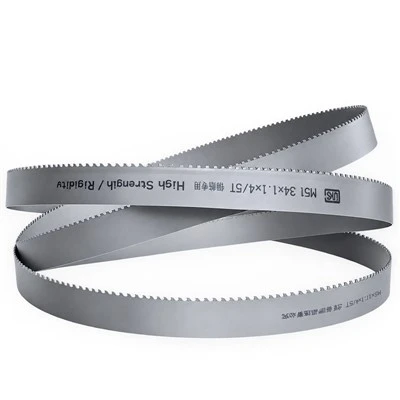

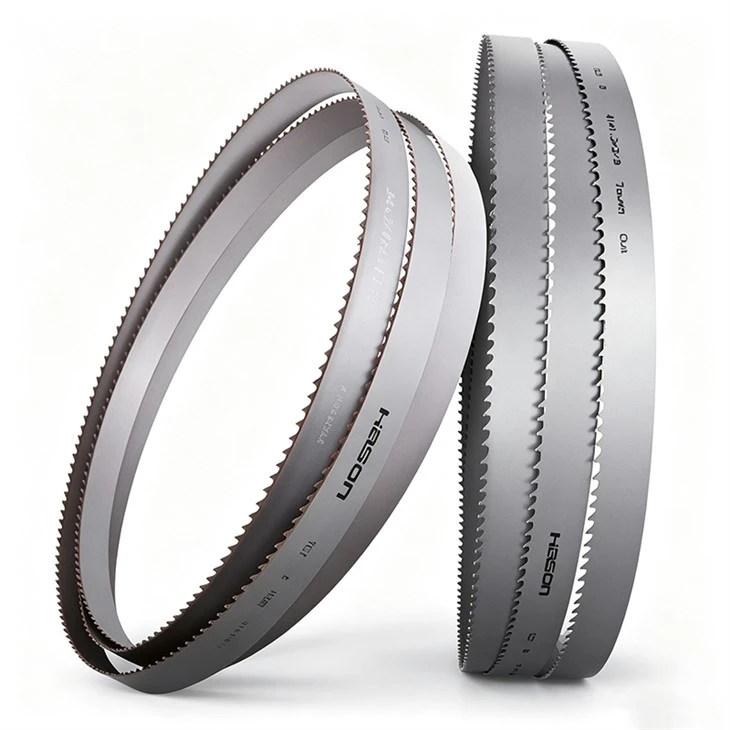


Product Introduction
A tungsten carbide metal blade is not an upgraded M42. It is a different cutting tool with a different cost structure, a different machine requirement, and a narrower-but far more demanding-application window.
In practice, the decision point sits around 45 HRC. Below that hardness, a bi-metal blade (M42 or M51) typically delivers the best cost-per-cut because it balances wear resistance with shock tolerance. Above that threshold-and especially on abrasive stainless, tool steel, nickel alloys, and high-silicon aluminium-the wear mechanism changes. Tooth tips dull by abrasion rather than by impact, and bi-metal blades begin to lose tooth geometry before the coil is spent. This is where a tungsten carbide metal blade changes the economics: the carbide tip does not resharpen in the cut, it resists wearing down in the first place.
Sipu supplies brazed carbide-tipped band saw blades with ground tooth profiles, built for B2B buyers who need a repeatable specification rather than a catalogue description. If your customers cut hardened stock, stack tubes, or run production saws at elevated surface speeds, the sections below are written for your specification sheet, not for a general audience.

Specification Table
| Parameter | Standard Range | Notes for Procurement |
| Tooth tip material | Micro-grain tungsten carbide (HM), brazed | Tip hardness typically ~1600 HV / approaching 100 HRC scale |
| Backing material | High-alloy spring steel, hardened and tempered | Matched to tip hardness to prevent premature strip wear |
| Width × thickness | 27 × 0.9 mm / 34 × 1.1 mm / 41 × 1.3 mm / 54 × 1.6 mm | 27 mm bodies are for light production saws; 41 mm and above for heavier stock |
| Tooth pitch (TPI) | 1.5/2, 2/3, 3/4, variable pitch | Finest practical pitch for carbide is generally 3/4 |
| Rake angle | 10° positive (standard), -18° available for hard stock | Positive rake for general steel; negative rake for high-hardness / interrupted-prone sections |
| Tooth form | Ground combi / triple-chip / high-low | Triple-chip geometry improves surface finish over bi-metal on hard materials |
| Welded loop length | Custom to machine; coil stock available | State machine make, model, and wheel diameter at enquiry |
| MOQ | 10–20 welded loops (standard); coil quantity by negotiation | Sample loops available for validation before bulk commitment |
The Procurement Decision B2B Buyers Actually Make
Distributors rarely ask "which blade is harder." They ask how many cuts per blade change, and what that does to the customer's downtime line.
On hardened stainless (17-4 PH, 440C) or tool steel above 50 HRC, a bi-metal blade may complete a limited number of cuts before the tooth tips round off or the blade begins to wander. The operator changes the blade, re-tensions, re-tracks, and restarts. That changeover cost-labour, scrap at the start of the next cut, and machine idle time-often exceeds the price difference between a bi-metal loop and a carbide loop. A carbide tipped band saw blade for hardened steel is bought against that changeover frequency, not against the blade invoice alone.
This is also why carbide blades are not a universal substitute. Carbide is hard but not shock-tolerant; Lenox states plainly that carbide blades are not recommended for interrupted cuts such as angle and tube sections, where bi-metal remains the superior choice. A distributor who sells carbide into a tube-cutting account will see premature tip chipping and returns. The correct sales logic is segment-based: carbide for solid, hardened, and abrasive stock on production saws; bi-metal for mixed-section work and lower-hardness general steel.
Failure Modes: What to Compare Before Quoting a Tungsten Carbide Metal Blade
| Failure mode | Bi-metal (M42/M51) behaviour | Tungsten carbide metal blade behaviour | Procurement implication |
| Tooth wear on abrasive stainless | Progressive rounding; cutting rate drops | Carbide tip retains edge geometry longer | Carbide reduces blade changes per month |
| Tooth chipping on interrupted cuts | High-speed steel absorbs shock | Carbide tip is brittle; chipping risk rises | Do not specify carbide for tube bundles or mixed sections |
| Body fatigue / weld failure | Weld quality is the dominant risk | Body and braze joint become critical | Enquire about braze integrity and backing hardness match |
| Cut deviation / "snaking" | Tension and tooth sharpness related | Carbide rigidity resists deviation when properly tensioned | Machine condition matters: worn guides accelerate carbide failure |
Machine Compatibility and Operating Parameters (Brief)
A tungsten carbide metal blade requires a saw designed for carbide: higher band tension capability, rigid guides, and sufficient horsepower to carry the recommended surface speed. Small tilting-frame workshop saws with 27 × 0.9 mm wheels are generally not designed for carbide-tipped blades, as RÖNTGEN notes in its own product documentation. Sipu confirms machine compatibility at quotation-send the machine make, model, and maximum band width, and we will flag whether the saw is carbide-ready before an order is released.
Break-in is not optional with carbide. The common industry procedure is to reduce band speed and feed rate by approximately 50% for the first 20 minutes, then increase in steps while listening for squeal or shriek; if the blade complains, the parameters are too aggressive. Distributors who skip break-in training for their end customers generate avoidable warranty conversations.
FAQ
Q: Can a tungsten carbide metal blade replace M42 on general mild steel cutting?
A: Technically it can cut mild steel, but the cost is rarely justified. M42 delivers a lower cost per cut on mild steel because the wear rate does not demand carbide's abrasion resistance. Carbide becomes the rational choice when hardness exceeds roughly 45 HRC or when the material is highly abrasive. Distributors should position carbide as a targeted upgrade, not a blanket replacement.
Q: Why do some carbide blades chip on the first cut while others run for weeks?
A: The most common cause is running carbide on an interrupted or unstable cut-square tube, bundled stock, or a saw with worn guide inserts. Carbide tips are hard but not shock-resistant. A secondary cause is skipping break-in: running a new carbide blade at full production feed from the first inch can micro-fracture the tip before the edge stabilises. A short break-in sequence and a rigidity check on the machine prevent most early failures.
Q: Do you supply carbide-tipped loops for specific saw brands, or only standard lengths?
A: Both. We weld to the length you specify from the machine manual, including older models where the original length is no longer listed by the OEM. Coil stock is available for distributors who prefer to weld in-house. The only information we cannot proceed without is the exact loop length or the machine model and wheel diameter.
Q: What is the typical MOQ and lead time for a private-label carbide blade order?
A: Standard unmarked welded loops start at 10–20 pieces. Private-label orders with laser marking and custom packaging typically begin at a higher quantity because the marking and packaging set-up is a fixed cost per run. Lead time for private-label carbide loops is generally longer than for unmarked stock because each loop is built and marked to order rather than pulled from a finished-goods bin.
Q: How should a distributor handle a customer who insists carbide is "too expensive"?
A: Reframe the comparison from blade price to cost per cut and changeover downtime. Ask how many blade changes the customer performs per week on the hardened or abrasive material, and what one changeover costs in labour and lost output. In many hardened-steel accounts, the carbide loop's longer interval between changes offsets the higher unit price before the blade reaches the end of its life. If the customer's cutting is mostly mild steel or mixed tube sections, the honest recommendation is bi-metal-and that credibility is worth more than a carbide sale.
Hot Tags: tungsten carbide metal blade, China tungsten carbide metal blade manufacturers, suppliers, factory, bandsaw blade for industrial machines, bandsaw blade for metal tubing, hardened steel bandsaw blade, heavy duty bandsaw blade, M51 Bandsaw, skip tooth bandsaw blade