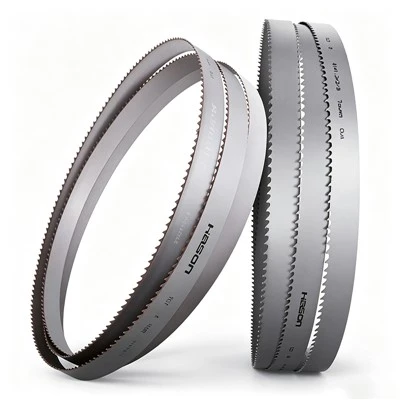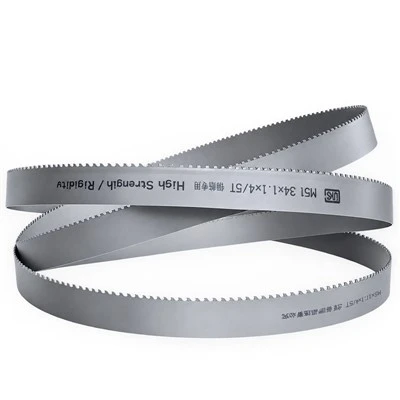


Product Introduction
M42 and M51 bi-metal band saw blades for production cutting of stainless steel (304/316), tool steel (Cr12MoV), alloy steel, bearing steel, titanium, and non-ferrous stock including 6061/7075 aluminum, copper, and brass. Tooth tips reach HRC 67–69 on M42 and HRC 68–70 on M51. The backing is a high-toughness alloy steel that resists fatigue cracking under repeated cycling. Widths: 13, 16, 19, 27, 34, 41, and 54 mm. Variable pitch options - 3/4, 4/6, 5/8, 8/12 TPI - break up resonance during cutting and improve chip clearance. Blades are welded to the customer's specified length for any commercial band saw. MOQ: 10 blades.
Technical Specification
| Parameter | M42 | M51 |
| Tooth tip material | HSS-Co8 (W2Mo9Cr4VCo8) | HSS with higher V and Co content |
| Tooth hardness | HRC 67–69 | HRC 68–70 |
| Red hardness | Maintains ~54–55 HRC at 600°C | Higher carbide content for improved wear resistance |
| Backing material | High-toughness alloy steel | High-toughness alloy steel |
| Width range | 13 / 16 / 19 / 27 / 34 / 41 / 54 mm | Same |
| Tooth pitch (TPI) | 3/4, 4/6, 5/8, 8/12 | Same |
| Tooth form | Variable pitch | Variable pitch |
| Weld type | CNC flash butt / laser | Same |
| Weld flatness tolerance | ≤ 0.02 mm | Same |
| MOQ | 10 blades |
10 blades |
Welding and Heat Treatment
Welding runs on CNC-controlled flash butt or laser equipment. Weld flatness deviation is held within 0.02 mm, which keeps the joint aligned with the blade body and reduces breakage risk at high cutting speeds. After welding, each blade goes through vacuum hardening and multi-stage tempering. This separates the hardness of the tooth edge from the toughness of the backing: the teeth stay sharp while the body absorbs feed shock without cracking.
The variable pitch geometry (e.g., 4/6 TPI) is ground on CNC tooth grinders. Against constant-pitch blades, measured noise reduction is 15 dB, with chip evacuation improving at the same time. Optional TiAlN PVD coating brings the friction coefficient down to 0.4 and allows cutting speed increases of up to 20% while reducing chip welding on the tooth face.
Application Matching
| Workpiece | Recommended pitch | Notes |
| Stainless steel 304/316 | 4/6 or 5/8 TPI | M51 preferred for high-nickel grades |
| Tool steel Cr12MoV, bearing steel | 3/4 or 4/6 TPI | M42 sufficient for general tool steel |
| 6061/7075 aluminum, copper, brass | 3/4 or 4/6 TPI | Coarse pitch clears soft chips |
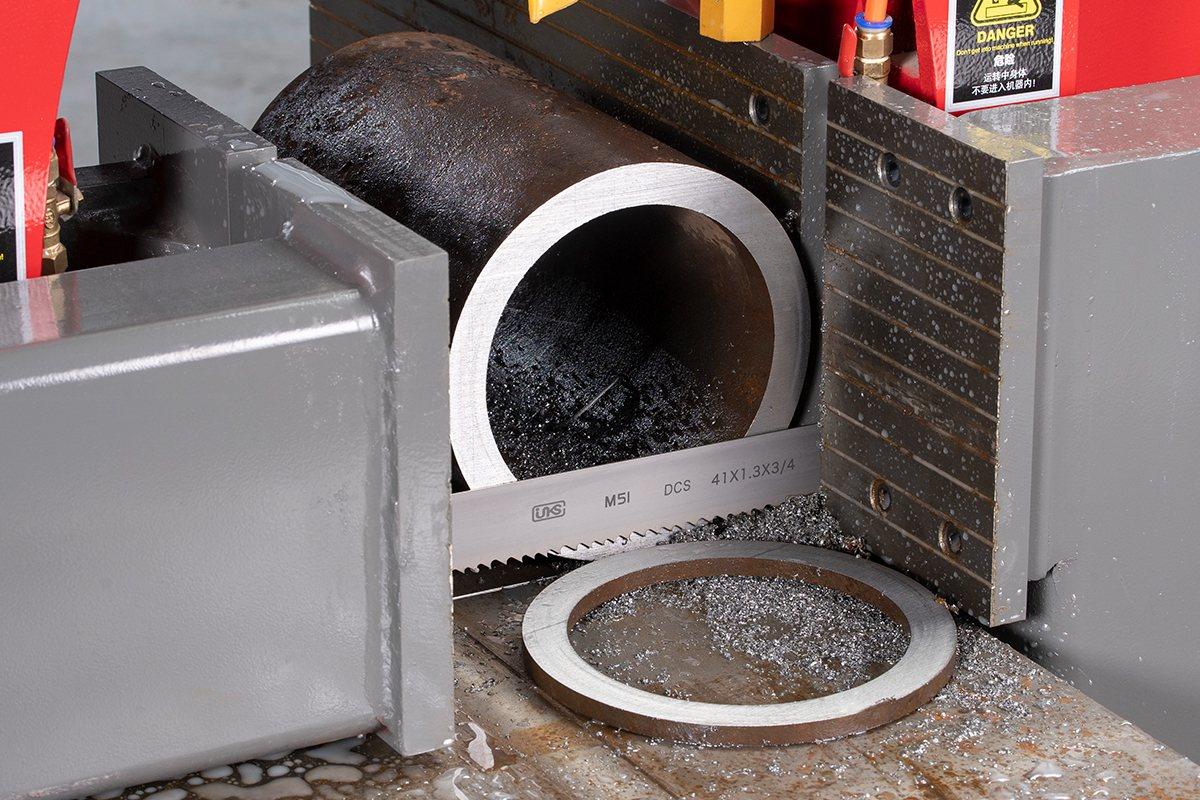
| Thick-wall pipe, I-beam | 4/6 or 5/8 TPI | Variable pitch limits vibration on hollow sections |
| Thin-wall tube | 8/12 or 10/14 TPI | Finer pitch prevents tooth stripping |
| Solid bar above 100 mm | 2/3 or 3/4 TPI | Coarse pitch for chip clearance at high feed |
Blades fit most commercial band saw machines. Welded loops are sized to the customer's machine model and cutting application. For distributors carrying multiple machine brands, loop lengths are customized per order without additional tooling charges.
Quality Control and Capacity
Seven automated production lines run a combined monthly capacity of 500,000 meters. Each production lot is checked with a full-auto vision measuring system, spectrometer, and metallographic analyzer. Tooth hardness, weld integrity, and pitch accuracy are recorded before packing.
Standard sizes ship from stock within 48 hours. Bulk and custom orders run 7–14 working days. Welds are guaranteed: if a weld fails before the teeth dull, the blade is replaced free of charge.
FAQ
Q: What is the difference between M42 and M51 for my application?
A: M42 covers general steel, stainless, and alloy stock at HRC 67–69. M51 carries higher vanadium and cobalt content, which raises carbide volume and wear resistance. For high-nickel alloys, titanium, or production runs where blade changes need to be less frequent, M51 is the choice. For mixed-shop cutting of 304/316, Cr12MoV, and standard alloy steel, M42 handles the range.
Q: Which TPI should I use for thick-wall pipe versus solid bar?
A: For tube and thin-wall sections, use 8/12 or 10/14 variable pitch. The finer teeth distribute cutting pressure across more teeth per inch, which prevents tooth stripping on hollow walls. For solid bar above 100 mm, use 2/3 or 3/4 TPI. The coarse pitch provides enough gullet capacity to clear chips at high feed rates.
Q: Does a new blade need break-in?
A: Yes. Run the first 20 minutes at 50% of normal feed rate. This hones the tooth edge and extends blade life. Cutting at full feed from the start can micro-fracture the tips before they settle into the cut.
Q: What happens if a weld fails before the teeth wear out?
A: Welds are guaranteed. A weld failure before tooth dullness is replaced free of charge. Weld flatness is held within 0.02 mm, and each lot is checked before packing. For distributors running high-volume production, this removes the most common breakage risk from the customer complaint chain.
Q: What is the lead time for 500 blades, and how are they packed?
A: 500 blades ship in 10–14 working days. Each blade gets anti-rust oil and VCI wrap; bulk orders go into fumigation-free wooden crates. Custom laser marking adds 2–3 days. For orders mixing multiple loop lengths, packing is organized by length and machine model to simplify receiving and warehouse sorting.
Hot Tags: heavy duty metal blade, China heavy duty metal blade manufacturers, suppliers, factory, industrial precision metal bandsaw blade, metal bandsaw blade for profiles, metal bandsaw blade for thick sheets, metal bandsaw blade for tube, narrow metal bandsaw blade, variable tooth pitch metal bandsaw blade