
In high-volume commercial sawmills operating across Spain, France, and broader European timber regions, unexpected downtime ruins production schedules. When primary breakdown lines stall because a blade snaps prematurely or wanders off the cut line, the financial impact extends far beyond the replacement cost of a single steel strip. For plant managers and procurement directors overseeing high-speed timber processing, identifying root causes rather than applying temporary fixes is essential to maintaining profitable mill operations.
1. Why Does a Wood Bandsaw Blade Snap Under High Tension?
Blade fracture in high-speed sawmills is rarely random. When inspecting failed bandsaw blades, maintenance engineers usually find that failure stems from a combination of mechanical stress, improper tensioning, or thermal fatigue. Understanding why steel fails under cyclic bending helps operations teams extend runtimes significantly.
Excessive or Insufficient Tension: Incorrect tension settings create excessive static stress that accelerates fatigue cracking along the root of the teeth.
Thermal Stress from Dull Teeth: Running dull blades forces operators to feed timber harder, generating immense frictional heat and thermal shock that hardens and embrittles the band body.
Wheel and Guide Misalignment: Misaligned guide blocks or worn-out wheel bearings put uneven torsional loads on the blade edge, resulting in rapid fatigue failure.
2. How to Prevent Blade Drift and Ensure Straight Cuts?
Blade drift-the tendency of the saw band to wander away from the intended cutting path-compromises lumber recovery rates and increases waste. In high-speed sawing operations processing dense European hardwoods and softwoods, precision is non-negotiable.
Improper Tooth Set: If tooth set is uneven or heavier on one side, the blade naturally pulls toward the set side. Regular checkups on set uniformity eliminate this issue.
Resin Build-up: Accumulation of resin, sap, and sawdust on the blade body alters friction and tracking. Continuous cleaning systems on high-speed mills prevent directional deviation.
Feed Rate Discrepancies: Incorrect feed speeds relative to timber density force the blade to deflect within the cut. Matching feed rate to motor load stabilizes the cutting kerf.


3. Selecting the Right Metallurgy for Heavy-Duty Timber Processing
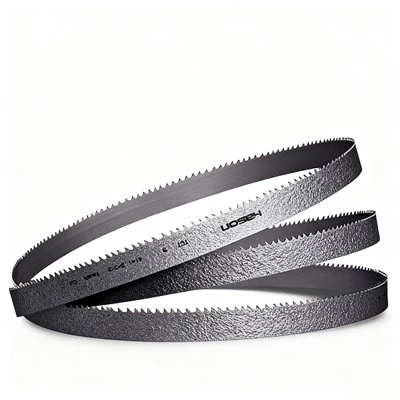
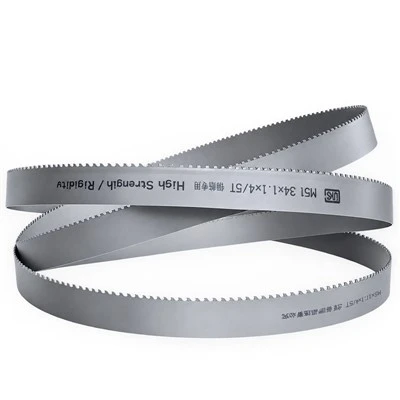
Solving recurring breakage and drift often starts before the blade ever touches a log. Selecting high-alloy carbon steel or bimetal bandsaw blades with optimized tooth geometry ensures superior fatigue resistance and tensile strength. Premium industrial saw blades undergo precise induction hardening on tooth tips, keeping the backing strip flexible enough to withstand continuous flexing around sawmill flywheels without cracking.
4. Why European Sawmills Partner with Sipu for Industrial Bandsaw Solutions
As an established specialist manufacturer dedicated exclusively to high-performance saw blades-rather than machinery production-Sipu combines advanced metallurgical engineering with strict quality control. Our manufacturing facility delivers distinct operational advantages for global timber exporters and regional distributors:
Superior Material Integrity: Every batch of steel undergoes rigorous spectral analysis and tensile testing to guarantee exceptional fatigue resistance and uniform hardness along the weld line.
Precision Manufacturing: Utilizing state-of-the-art CNC grinding and automated tooth setting equipment, Sipu blades achieve exact dimensional tolerance, reducing kerf loss and ensuring clean, straight cuts.
Reliable B2B Partnership: We support international distribution networks with stable bulk supply capabilities, custom OEM labeling, and responsive engineering support tailored to regional mill requirements.


Conclusion
Minimizing downtime in high-speed sawmills requires a proactive approach to blade maintenance, tension control, and material selection. By partnering with a dedicated manufacturer like Sipu, timber processing plants in Spain, France, and beyond secure dependable, high-precision cutting tools engineered to withstand the most demanding operational environments.